
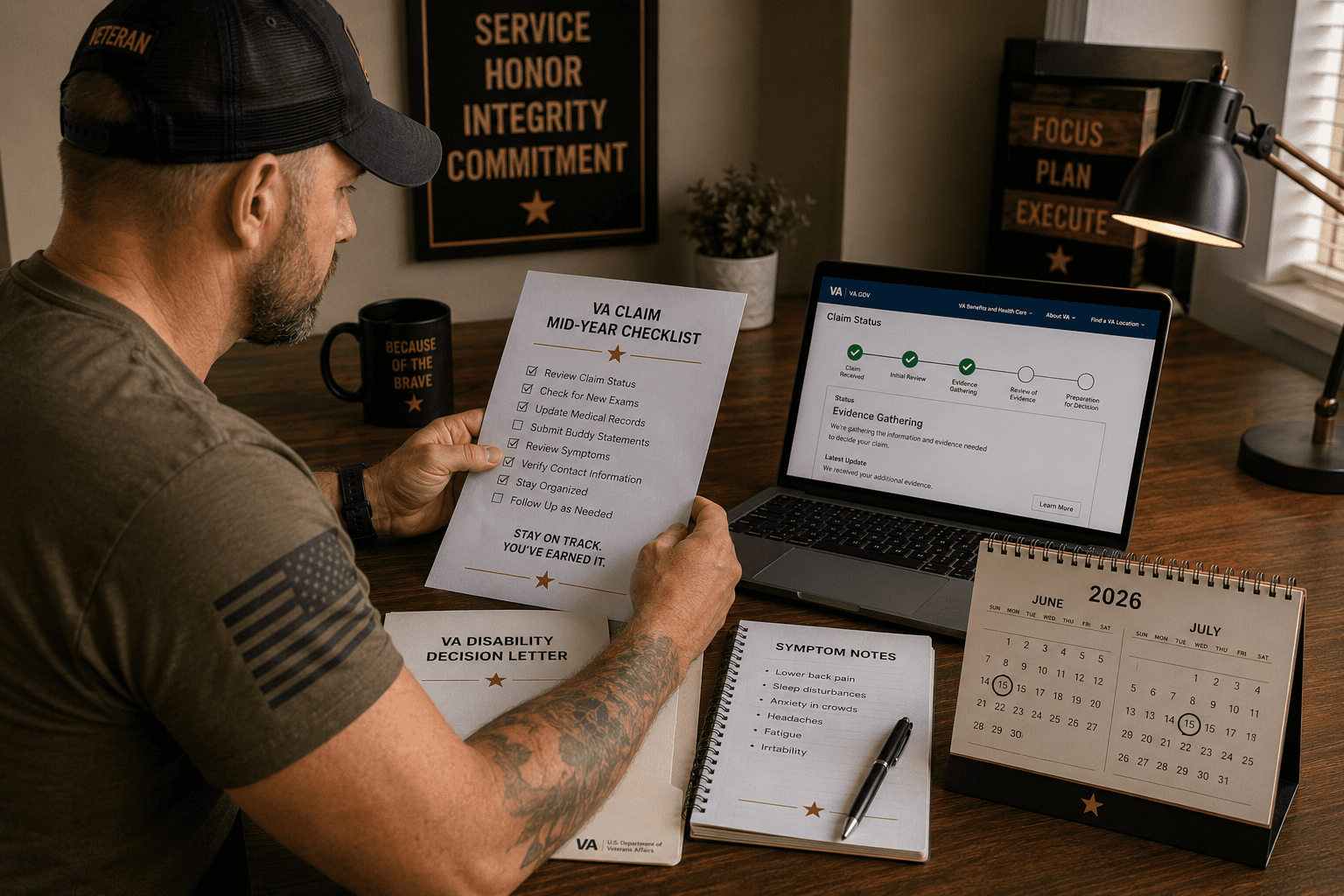
VA Claim Mid Year Review 2026: What Veterans Should Check Now
VA claim mid year review 2026 is a smart way for veterans to pause, check claim status, review evidence, and decide whether the next six months require action. Many veterans file a claim, wait, and hope everything works out. However, a mid-year review can reveal missing records, worsening symptoms, decision-review deadlines, or secondary conditions before they become bigger problems.
What Should I Check During a VA Claim Mid-Year Review in 2026?
Why a Mid-Year VA Claim Review Matters
A VA disability claim can stretch across months. During that time, symptoms can change, treatment can continue, records can arrive late, and VA may ask for more information. Additionally, veterans may receive a decision and miss the importance of the deadline printed in the letter.
Mid-year is a useful checkpoint because it gives veterans time to act before the year ends. For example, a veteran who filed in January may still be waiting in June. Another veteran may have received a March denial and still have time to choose the right decision-review lane. Meanwhile, someone with a stable rating may notice symptoms have worsened since winter.
Warrior Allegiance’s guide to VA disability claims support explains why organization, timing, and evidence can affect how clearly a claim is presented.
VA Claim Mid-Year Review 2026 Checklist
Use this table as a practical starting point. It does not replace VA rules, but it helps veterans match their claim situation to the right review task.
| Claim situation | What to review | Evidence to gather | Possible next step | Mistake to avoid |
|---|---|---|---|---|
| Pending claim | VA.gov status, requests, C&P exam notices | Updated treatment, records VA requested, contact info | Respond quickly and track deadlines | Ignoring VA letters |
| Denied claim | Decision reasons, missing nexus, evidence gaps | New and relevant records, medical opinions, lay statements | Supplemental Claim or review option | Refiling without fixing the reason |
| Low rating | Rating criteria, symptoms, exam findings | Symptom logs, treatment notes, work impact examples | Increase claim or decision review | Assuming VA saw all severity evidence |
| Worsening symptoms | Changes since January, new limitations | Recent appointments, medication changes, flare-up notes | Consider rating increase strategy | Waiting until symptoms are undocumented |
| Secondary condition | New issue linked to service-connected disability | Diagnosis, nexus evidence, treatment history | File secondary claim with support | Filing without connection evidence |
| Missed evidence | Records not submitted or not reviewed | Private records, STRs, buddy statements | Submit through proper claim lane | Uploading random documents without context |
Check Your VA Claim Status First
The first step in a VA claim mid year review 2026 is checking status. Look at whether your claim is still in evidence gathering, review, preparation for decision, or another stage. Also, confirm whether VA requested records, scheduled a C&P exam, or asked you to submit forms.
Next, check your contact information. A missed exam notice or outdated address can create avoidable problems. Therefore, confirm your mailing address, phone number, email, and VA.gov account access.
Also, save screenshots or notes from your status check. You do not need to obsess over every status update, but you should know whether VA is waiting on you, a provider, or an exam contractor.
Review Your Evidence Folder
Your evidence folder should tell a clear story. A strong claim usually shows a current disability, an in-service event or service-connected connection, and evidence of severity. If your folder is scattered, the mid-year review is the time to clean it up.
Useful records may include service treatment records, VA medical records, private treatment notes, imaging, labs, prescriptions, C&P exam notices, lay statements, personal statements, and employer or family observations. Additionally, veterans should keep decision letters and claim submissions in the same folder.
If you submitted private records, confirm whether VA received them. If you planned to submit buddy statements but never did, write down who can provide them and what they personally observed.
What to Do If Your Symptoms Changed Since January
Symptoms can change quickly. Pain may worsen, migraines may become more frequent, mental health symptoms may interfere with work, or a secondary condition may appear after months of compensating for another disability.
If your symptoms changed since January, start documenting now. Schedule treatment when appropriate. Track frequency, severity, duration, medication changes, missed work, flare-ups, mobility limits, panic attacks, sleep problems, digestive episodes, or other measurable impacts.
A rating increase may make sense when a service-connected condition has worsened and the evidence supports that change. However, do not file an increase just because time passed. File because the current rating may no longer match your documented severity.
VA rating increase guide →Review Decision Letters and Deadlines
If you received a VA decision in the first half of 2026, read the letter carefully. Do not only look at the percentage. The decision letter can explain why VA granted, denied, deferred, or rated a condition at a certain level.
Specifically, look for the evidence VA reviewed, reasons for denial, effective date, rating percentage, and any favorable findings. If a condition was denied because there was no nexus, you may need a different kind of evidence than someone denied because no current diagnosis was found.
Deadlines matter. Some decision-review options must be chosen within specific timeframes. Therefore, a mid-year review helps you avoid waiting until the deadline is too close to gather useful evidence.
Decide Whether You Need New Evidence
Not every claim problem needs the same solution. If the decision was wrong based on evidence already in the file, a review option may make sense. If you have new and relevant evidence, a Supplemental Claim may be the stronger path. If symptoms worsened after the decision, an increase claim may be the better fit.
New evidence can include updated treatment records, private medical opinions, nexus letters, imaging, diagnosis notes, medication history, symptom logs, and lay statements. However, more paper is not always better. Evidence should answer the specific problem in the claim.
For example, if VA denied a knee condition because there was no current diagnosis, a buddy statement alone may not fix the issue. Meanwhile, if VA acknowledged the condition but rated it too low, detailed severity evidence may matter more.
Watch for Secondary Conditions
A VA claim mid year review 2026 should also include secondary conditions. A secondary condition is a disability caused or aggravated by an already service-connected condition. These are easy to miss because veterans often focus only on the original injury or diagnosis.
For example, a knee condition may affect gait and contribute to hip or back problems. PTSD or chronic pain may contribute to sleep issues. Medication side effects may create digestive or other problems. However, secondary claims usually need medical evidence connecting the conditions.
Warrior Allegiance’s VA secondary conditions list can help veterans think through possible connections before filing unsupported claims.
Common Mid-Year Claim Mistakes to Avoid
A mid-year review helps only if it leads to better decisions. Avoid acting out of panic, frustration, or rumors.
- Ignoring decision letters. The reasons for denial or low rating tell you what needs attention.
- Filing an increase without evidence. Worsening symptoms should be documented before filing when possible.
- Submitting unrelated documents. Evidence should connect clearly to the issue VA is deciding.
- Missing exam notices. C&P exams can affect outcomes, so keep contact details current.
- Confusing claim lanes. Supplemental Claims, Higher-Level Reviews, appeals, and increases serve different purposes.
- Forgetting secondary conditions. New symptoms may be related to service-connected disabilities.
As a result, veterans should review first, organize second, and file only when the next step matches the evidence.
How to Build a 2026 Claim Action Plan
A clear action plan turns the review into progress. Start with a one-page summary that lists each claimed condition, current status, rating or denial reason, missing evidence, deadline, and next action.
Next, sort each condition into one of four categories: wait and monitor, gather evidence, request review, or consider increase. This prevents every issue from feeling equally urgent.
Finally, set reminders. Add dates for evidence requests, medical appointments, C&P exams, decision-review deadlines, and follow-up calls. A VA claim calendar can reduce stress because it turns uncertainty into tasks.
VA claim assistance guide →Frequently Asked Questions
Q1 What is a VA claim mid year review 2026? +
Q2 Should I check my VA claim status every day? +
Q3 What should I do if my VA symptoms got worse in 2026? +
Q4 What if my VA claim was denied earlier this year? +
Q5 Can a mid-year review help with secondary conditions? +
Get Help Reviewing Your VA Claim in 2026
VA claim mid year review 2026 is not about rushing into more paperwork. It is about knowing where your claim stands, what evidence is missing, whether symptoms changed, and which next step actually fits your situation.
Warrior Allegiance helps veterans review claim decisions, organize evidence, and understand rating or increase strategies with clarity. If your claim feels stuck, confusing, or incomplete, a mid-year review can help you move forward with a stronger plan.