
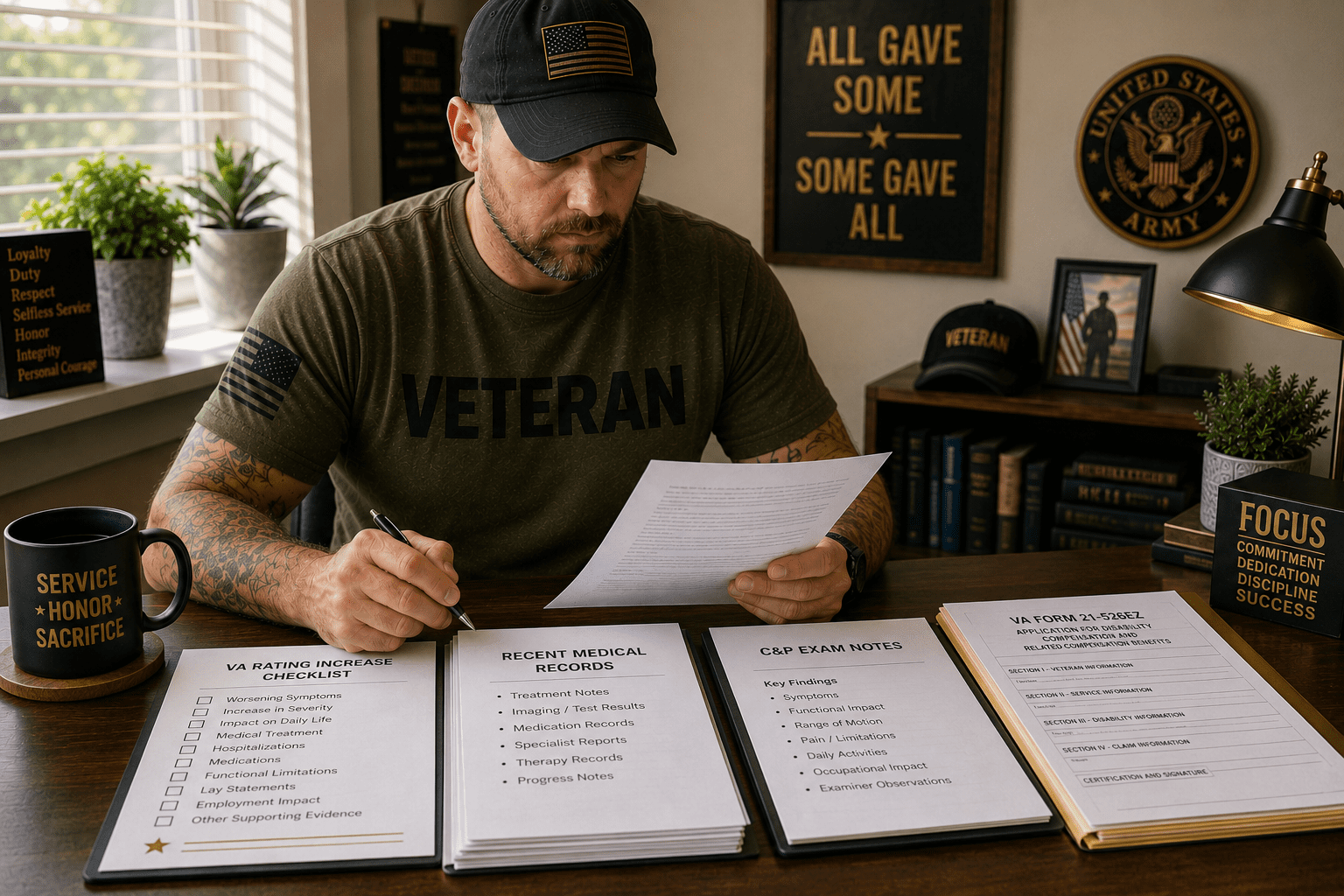
How to Request VA Rating Increase 2026: What Veterans Should Know
How to request VA rating increase 2026 is a question many veterans ask when a service-connected condition gets worse, treatment changes, or a current rating no longer matches daily life. A higher rating may be possible, but the strongest request is built on evidence of worsening, not just frustration with the old decision.
How Do I Request a VA Rating Increase in 2026?
Why Veterans Request VA Rating Increases
Veterans usually request increases because symptoms have worsened over time. A back condition may now limit sitting, bending, or walking. PTSD may create more serious work and relationship impairment. Migraines may happen more often. GERD, sleep apnea, knee pain, neuropathy, or other conditions may now require stronger treatment.
Additionally, a condition that was once manageable may begin affecting work, sleep, driving, family life, concentration, mobility, or independence. Those real-life changes matter because VA ratings are tied to severity and functional impact.
Warrior Allegiance’s guide to VA disability claims support explains why organized evidence can help veterans better understand what the VA needs before filing, appealing, or requesting a higher rating.
Which VA Path Should You Choose?
Use this table as a practical guide. It does not replace official VA rules, but it can help veterans understand the difference between common claim paths.
| VA path | Best used when | What you ask VA | Helpful evidence | Watch out for |
|---|---|---|---|---|
| Increased-rating claim | A service-connected condition got worse | Reevaluate the current severity | Recent treatment records, lay statements, C&P examples, work impact | Filing without evidence of worsening |
| Supplemental claim | You have new and relevant evidence after a decision | Reconsider the issue with new evidence | New medical records, nexus opinion, corrected evidence | Using it when no new evidence exists |
| Higher-level review | You think VA made an error using the existing record | Have a senior reviewer re-check the decision | Clear argument about the error | No new evidence allowed |
| Board appeal | You want a Veterans Law Judge to review the case | Appeal the decision to the Board | Depends on docket choice | Longer timelines and strategy choices |
| Secondary-condition claim | A service-connected condition caused or worsened another condition | Service connect the related condition | Diagnosis, medical opinion, medication history, gait notes | Assuming the connection is obvious |
Evidence of Worsening for a VA Increase
Evidence of worsening is the center of how to request VA rating increase 2026. The VA needs to see that the service-connected condition is more severe than the current rating reflects.
Helpful evidence may include updated VA or private treatment records, imaging, labs, prescription changes, physical therapy notes, mental health notes, emergency care, specialist visits, and symptom logs. Also, lay statements from spouses, family members, coworkers, or friends can describe changes they personally observe.
However, evidence should be specific. “My condition is worse” is weaker than “I now miss work twice a month due to migraines” or “I can stand for 10 minutes before back pain forces me to sit.” Clear examples help connect worsening to rating criteria.
How Functional Impact Affects Rating Increases
VA rating increases often depend on how symptoms affect ordinary life. Therefore, veterans should document functional impact, not only pain level or diagnosis.
Functional impact may include reduced range of motion, missed work, panic attacks, sleep disruption, difficulty walking, problems lifting, isolation, medication side effects, flare-ups, or needing help with daily tasks. For mental health ratings, work and social impairment are especially important. For musculoskeletal ratings, movement limits, painful motion, weakness, and flare-ups may matter.
Additionally, veterans should describe bad days. A short exam may not capture the worst symptoms unless the veteran explains how often flare-ups happen, how long they last, and what they prevent the veteran from doing.
What to Know About C&P Exams for Increase Claims
Most increase claims involve a C&P exam. The exam is not a courtroom, but it is also not a casual conversation. The examiner may ask about symptoms, treatment, flare-ups, work impact, daily limitations, and how the condition has changed since the prior rating.
Veterans should answer honestly and specifically. For example, instead of saying “my knee hurts,” explain when it hurts, how far you can walk, whether it swells, whether stairs are difficult, whether you use a brace, and whether flare-ups limit movement. For PTSD or depression, describe frequency, severity, work impact, social impairment, sleep issues, panic, memory problems, and safety concerns if they apply.
Do not exaggerate. However, do not minimize either. Many veterans say “I’m fine” out of habit, and that can make the claim file look less severe than daily life really is.
When an Appeal May Be Better Than an Increase
Sometimes the best move is not an increase request. If the VA recently denied a higher rating and the veteran believes the decision was wrong, an appeal path may make more sense.
For example, if the VA ignored evidence, misread symptoms, or failed to consider records already submitted, higher-level review or Board appeal might be the better path. If the veteran has new and relevant evidence, a supplemental claim may fit. If the issue is a newly developed condition caused by a service-connected disability, a secondary claim may be better.
This matters because an increase claim usually focuses on current worsening. An appeal may protect an earlier effective date if handled correctly. As a result, veterans should review the decision letter before choosing a path.
How to Request VA Rating Increase 2026 Step by Step
Start by reading your most recent rating decision. Identify the condition, current rating, effective date, and reason VA gave for the rating. Then compare that decision with your current symptoms.
Next, gather evidence of worsening. Include current treatment notes, symptom logs, medication changes, work records, lay statements, and examples of flare-ups or daily limitations. If a secondary condition has developed, gather diagnosis and nexus evidence for that issue too.
Then file the correct request. For an increased-rating claim, veterans commonly use VA Form 21-526EZ or file online through VA.gov. After filing, prepare for a C&P exam and keep copies of everything submitted.
VA claim assistance guide →Common Mistakes in VA Rating Increase Requests
A rating increase request can be delayed, denied, or underrated when the evidence does not clearly show worsening.
- Filing too soon without evidence. A worsening claim needs current records or credible observations.
- Choosing the wrong path. An appeal, supplemental claim, or secondary claim may be better than an increase.
- Minimizing symptoms at the C&P exam. Be honest about bad days, flare-ups, and daily limits.
- Only repeating the diagnosis. VA already knows the condition is service connected; now it needs severity evidence.
- Ignoring work impact. Missed work, reduced duties, accommodations, or job changes can matter.
- Skipping lay statements. Family members or coworkers may describe changes medical records miss.
As a result, the best increase requests are specific, current, and organized around the rating criteria.
Common VA claim mistakes →Frequently Asked Questions
Q1 How to request VA rating increase 2026 if my condition got worse? +
Q2 What evidence do I need for a VA rating increase? +
Q3 Should I file an increase or appeal my VA decision? +
Q4 Can a secondary condition increase my VA rating? +
Q5 Can my rating go down if I request an increase? +
Get Help Requesting a VA Rating Increase
How to request VA rating increase 2026 comes down to choosing the right path, proving worsening, and explaining how the condition affects real life. A stronger request is not just more paperwork. It is clearer evidence.