
What to Expect at a VA C&P Exam in 2026: The Complete Preparation Guide
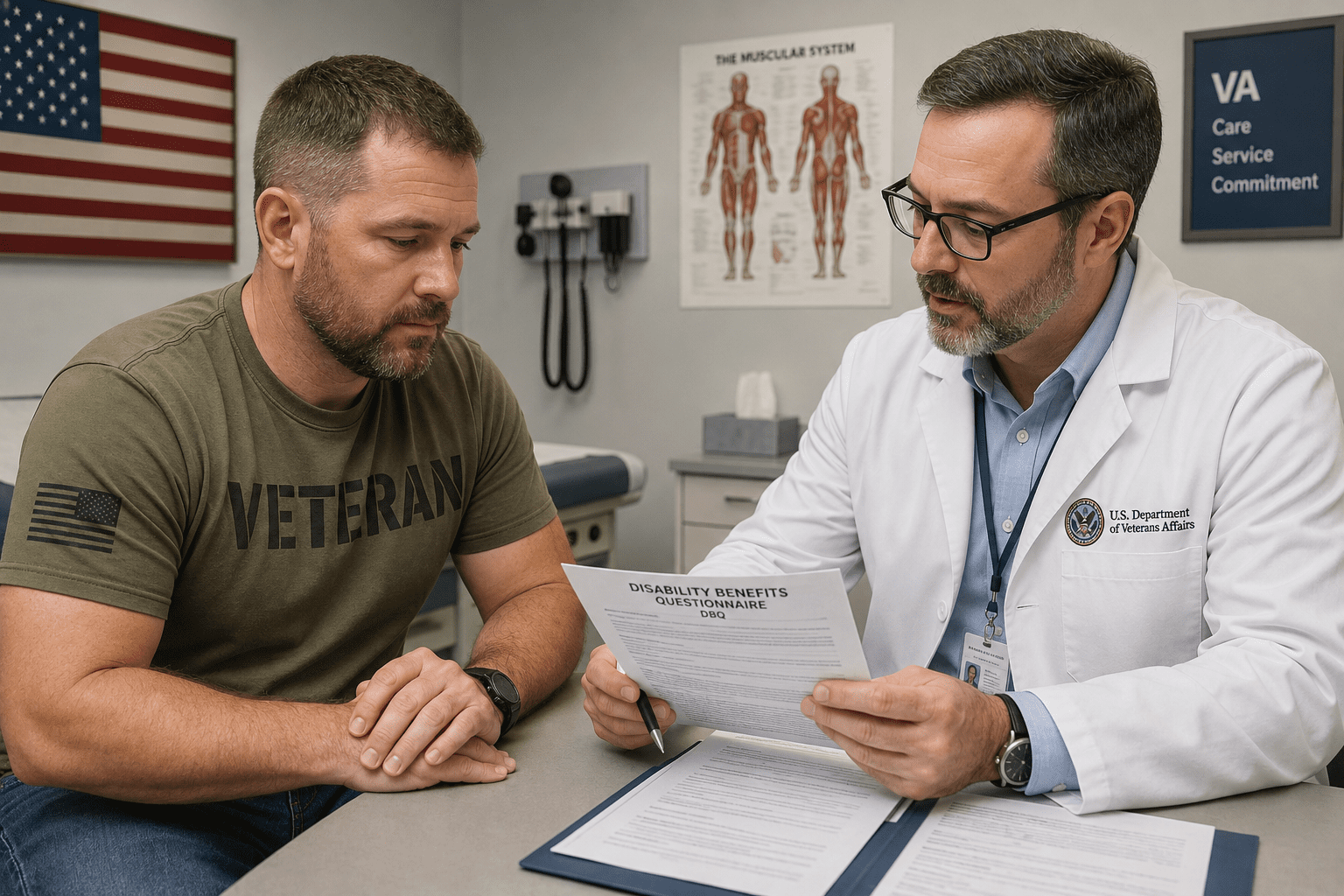
If you have a VA C&P exam coming up and you are not sure what to expect, you are not alone — and the preparation you do before you walk in matters more than most veterans realize. The C&P exam is not a treatment appointment. It is an evidence-gathering session, and the examiner's report will directly shape your disability rating and every dollar of monthly compensation attached to it. This guide covers what to expect at a VA C&P exam in 2026, what the examiner is actually scoring, and exactly how to prepare so your rating reflects your real condition. For the VA's official overview of the claim exam process, see the VA claim exam page at VA.gov.
What to Expect at a VA C&P Exam in 2026 — Quick Answer
Why the VA C&P Exam Is the Most Important Hour in Your Claim
Most veterans assume the hard work is done once they submit their paperwork. It is not. The C&P exam is where claims are won or lost — and the margin between a prepared veteran and an unprepared one is measured in rating points that translate directly to monthly income for life.
At 2026 rates, the difference between a 30% rating ($524.31/month) and a 70% rating ($1,808.45/month) is $1,284 per month — $15,408 per year — driven almost entirely by how well the examiner documents your functional impairment. Veterans who walk in underprepared routinely describe their good days, say "I'm fine" when asked how they feel, and leave with a rating that reflects neither their worst days nor their actual limitations.
The VA examiner sees you for 20 to 45 minutes. They do not see the mornings your back locks up, the nights you wake from nightmares, or the weeks you cannot leave the house. Your job in that room is to make sure the examiner's DBQ captures all of it.
VA C&P Exam Types at a Glance — 2026
Not every C&P exam works the same way. The format depends on your condition, your evidence, and what the VA determines it needs to complete your rating decision.
| Exam Type | Format | Best For | Attendance | What Examiner Documents |
|---|---|---|---|---|
| In-Person | Face-to-face at VA or contractor clinic | Musculoskeletal and physical conditions | Required | Full physical evaluation, ROM measurements, DBQ |
| Telehealth | Secure video from home | Mental health, hearing, some musculoskeletal | Required | Structured clinical interview, DBQ |
| ACE Review | Records-only — no appointment | Well-documented conditions with strong existing evidence | Not required | DBQ completed from existing file; examiner may call |
| Private DBQ | Veteran's own treating physician | Supplemental or appeal evidence | Required (with your doctor) | Same DBQ form, completed by private provider |
As of 2026, approximately 93% of C&P exams are conducted by third-party contractors — VES, QTC, OptumServe, and Loyal Source — rather than VA staff. Contract examiners follow the same training and certification standards as VA providers. However, they may not be specialists in your specific condition, and exams can run as short as 20 minutes. Consequently, your preparation determines how complete the DBQ becomes.
What Happens at a VA C&P Exam in 2026 — Step by Step
Understanding the sequence before you arrive removes the anxiety of the unknown and lets you focus entirely on communicating your condition accurately.
What the Examiner Is Actually Scoring — The DBQ Explained
This is what most preparation guides miss entirely. The examiner is not simply asking how you feel. They are filling out a condition-specific DBQ that maps your answers directly to rating thresholds under 38 C.F.R. Part 4. Understanding this changes how you answer every question in the room.
Musculoskeletal Conditions — Back, Knees, Hips, Shoulders
The DBQ captures range-of-motion measurements in degrees, whether pain limits motion before end range, and whether flare-ups reduce function beyond the baseline exam. Each measurement maps to a specific rating percentage. A knee that measures 45° of flexion on a good day rates differently than one that measures 45° on a good day but locks up for three days after any sustained walking. Under the DeLuca v. Brown standard, VA regulations require documentation of flare-up severity even when it cannot be reproduced during the exam itself. Stop at the onset of pain during range-of-motion testing — do not push through — and say clearly that you are stopping because of pain. If you do not report it, the examiner cannot document it.
Mental Health Conditions — PTSD, Anxiety, Depression
For mental health conditions, the DBQ captures occupational and social impairment — specifically whether your symptoms cause occasional decreases in work efficiency, frequent decreases, or near-total impairment. The rating levels for PTSD and all other mental health conditions under the VA's General Rating Formula (38 C.F.R. § 4.130) are 0%, 10%, 30%, 50%, 70%, and 100%, each defined by degree of functional impairment, not by symptom count.
Strong: "I have nightmares three to four nights per week. As a result, I arrive at work exhausted and I have been written up twice for falling asleep at my desk. I have stopped attending my son's school events because crowded rooms trigger hypervigilance that takes hours to come down from."
The second answer documents occupational and social impairment at a specific rating level. The first documents a symptom. The difference can be 20 to 40 rating points.
Tinnitus and Hearing Loss
Tinnitus exams involve audiological testing and a clinical interview about symptom frequency and functional impact. Tinnitus itself rates at a fixed 10% — however, its secondary connections to anxiety, migraines, and sleep disorders each carry independent ratings. Mention every secondary symptom your tinnitus produces during the exam. Additionally, note how tinnitus affects your concentration, sleep quality, and daily communication, because these functional impacts feed directly into the secondary condition ratings the examiner can document.
What to Say — and What Not to Say — at Your VA C&P Exam
The language you use in the exam room directly determines what the examiner can write in the DBQ. Vague answers produce vague documentation. Specific, functional answers produce specific, documentable findings. Here is the clearest version of the distinction.
What to Do If Your VA C&P Exam Was Inadequate
Not every C&P exam produces an adequate DBQ. If your examiner did not measure passive range of motion, did not ask about flare-ups, did not document secondary symptoms, or made factual errors in the report, you have grounds to challenge the exam under Barr v. Nicholson, 21 Vet. App. 303 (2007) — which requires the VA to ensure exam adequacy before making a rating decision.
Step 1 — Request Your DBQ
Request a copy of your completed DBQ through your VA.gov account under My HealtheVet, through your VSO, or by filing a Freedom of Information Act (FOIA) request. Review it carefully against what you actually said during the exam and against the rating criteria for your condition. Specifically, check whether flare-ups were documented, whether passive range of motion was tested separately from active range of motion, and whether secondary symptoms were captured.
Step 2 — Choose Your Response
If the DBQ is missing critical findings, you have three options. First, you can request a new exam, citing specific inadequacies by name — for example, failure to test passive ROM or failure to document flare-up severity. Second, you can submit a private DBQ from your own treating physician as supplemental evidence; a private DBQ from a doctor who has treated you over time carries significant weight when it directly addresses the gaps in the original. Third, you can file a Supplemental Claim with a nexus letter that addresses the specific documentation failures in the original exam report. Most successful rating increases after a poor C&P exam come from a Supplemental Claim paired with a private DBQ that captures what the original examiner missed.
Learn How Warrior Allegiance Prepares Veterans for Every Stage →Frequently Asked Questions — What to Expect at a VA C&P Exam in 2026
Q1 What should I expect at my VA C&P exam in 2026? +
Q2 Can I bring someone to my VA C&P exam? +
Q3 What happens if I miss my VA C&P exam? +
Q4 How do I get a copy of my C&P exam results? +
Q5 What if my C&P exam rating came back lower than expected? +
You Prepared for Service. Prepare for This Exam the Same Way.
Knowing what to expect at a VA C&P exam in 2026 is not optional preparation — it is the difference between a rating that reflects your real condition and one that reflects 45 minutes of underprepared answers. Warrior Allegiance is a veteran-owned organization based in El Paso, Texas, with a 90%+ approval rate and a team that has guided veterans through every stage of the claims process since 2021. We help you prepare for your C&P exam the right way — reviewing your evidence, identifying documentation gaps, and making sure the examiner's DBQ captures everything your service cost you. No upfront fees. Free consultation.