
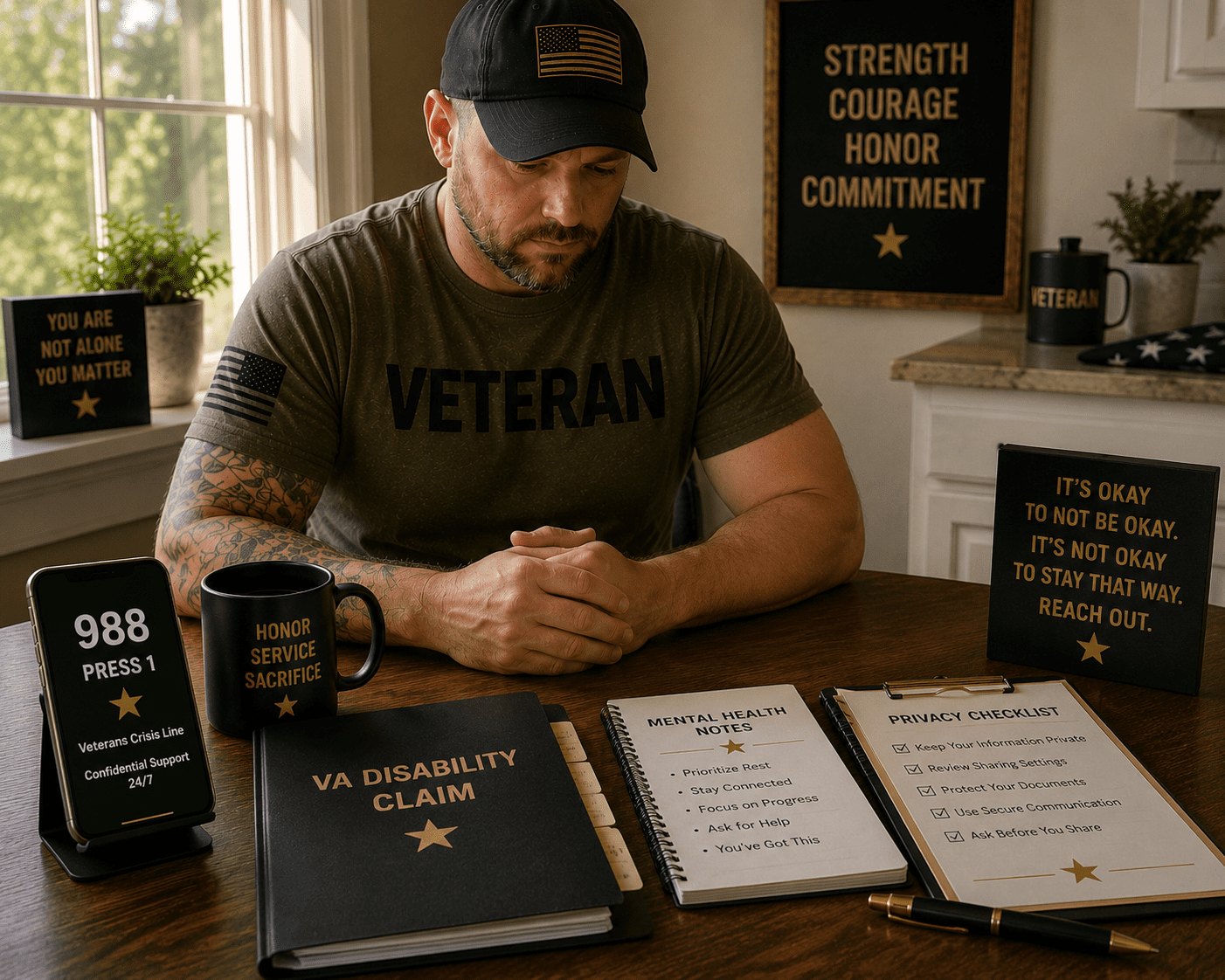
Veterans Crisis Line VA Disability Claim Confidentiality: What Veterans Should Know
Veterans crisis line VA disability claim confidentiality is a serious concern for veterans who need help but worry that calling, texting, or chatting with the Veterans Crisis Line could hurt a VA disability claim. That fear can make someone hesitate when support matters most.
Can Calling the Veterans Crisis Line Affect My VA Disability Claim?
Why This Question Matters
This topic matters because veterans may avoid mental health support when they are worried about ratings, claims, firearms, employment, family privacy, or future exams. That hesitation can be dangerous. Crisis support exists so veterans can talk to someone immediately, even if they are not enrolled in VA health care or benefits.
Additionally, VA disability claims can already feel intimidating. Veterans may believe one call, one note, or one emotional moment will define their entire claim. However, claim decisions are not supposed to rely on fear or assumptions. They are based on evidence, symptoms, diagnosis, service connection, severity, and functional impact.
Warrior Allegiance’s guide to VA disability claims support explains why organized evidence can make the claims process clearer and less overwhelming.
Crisis Line Privacy vs VA Claim Evidence
Use this table as a practical guide. It does not replace official privacy rules, but it helps separate crisis support from claim evidence.
| Situation | What it means | Claim evidence? | Privacy point | Veteran takeaway |
|---|---|---|---|---|
| Veterans Crisis Line contact | Immediate confidential support by phone, text, or chat | Not automatically the same as claim evidence | You choose what to share; exceptions may apply | Get help first if you are in crisis |
| Emergency risk | Safety intervention may be needed | Depends on records created later | Privacy can be limited for imminent safety | Emergency help is about keeping you alive |
| VA treatment records | Ongoing care through VA health services | Often relevant if VA obtains or reviews them | Medical records have privacy protections | Treatment can document symptoms and support care |
| C&P exam | VA exam for claim evaluation | Yes, exam reports are claim evidence | Exam is part of the disability claim process | Be honest and specific about symptoms |
| Lay statements | Written observations from others | Yes, if submitted | You control what statements you submit | Use statements to explain real-world impact |
What the Veterans Crisis Line Is For
The Veterans Crisis Line exists for veterans, service members, National Guard and Reserve members, and their loved ones who need immediate support. You can call 988 and press 1, text 838255, or use online chat to connect with trained responders.
You do not have to prove you are “bad enough” to reach out. You also do not need to be enrolled in VA health care or already receiving VA benefits. If you are overwhelmed, thinking about self-harm, worried about someone else, or unsure what to do next, the line is there.
Therefore, the safest rule is this: if you are in immediate danger or worried you may hurt yourself or someone else, contact emergency help now. A disability claim can be sorted out later. Your safety comes first.
What Confidentiality Usually Means
Confidentiality means your conversation is treated as private support. You can decide how much personal information to share. You may give your name, location, or contact information, but you may also be cautious if you are not ready to share everything right away.
However, confidentiality is not absolute in every situation. Like many crisis and health services, privacy limits can apply if there is an imminent safety concern, if you give permission for a referral, or if disclosure is required by law. This does not mean veterans should avoid calling. It means the system has emergency safeguards when someone may be at serious risk.
In practical terms, veterans should not confuse confidentiality with “nothing can ever be documented anywhere.” Instead, think of the Crisis Line as confidential help with safety-focused exceptions.
How VA Disability Claims Use Evidence
VA disability claims are usually decided based on evidence. That can include service treatment records, VA medical records, private medical records, C&P exam reports, buddy statements, personal statements, military records, and other supporting documents.
For mental health claims, the VA may look at diagnosis, symptoms, service connection, treatment history, occupational and social impairment, and how the condition affects daily life. A veteran’s overall record matters more than a single moment of distress.
This is where veterans crisis line VA disability claim confidentiality gets misunderstood. A crisis conversation is not automatically a full disability claim record. Meanwhile, treatment records, C&P exams, and submitted statements may become part of claim evidence when VA properly obtains or reviews them.
PTSD VA rating mistakes →Should You Worry About Calling If You Have a Pending Claim?
If you have a pending claim and you are in crisis, call, text, or chat anyway. Your immediate safety is more important than any claim worry. Also, asking for help does not mean you are weak, dishonest, unstable, or trying to manipulate the claims process.
If you are concerned about how mental health evidence may affect your claim, separate the issues. First, get help and stabilize. Then, when you are safe, review your claim evidence, treatment records, C&P exam expectations, and decision letters with support.
Additionally, do not hide symptoms because you are afraid they sound “too severe.” Mental health ratings depend on honest reporting of symptoms and functional impact. Minimizing can hurt care and can also make the claim record less accurate.
What to Do If You Are Worried About Your Claim
If claim fear is stopping you from reaching out, use a simple plan. First, save the Veterans Crisis Line number now: call 988 and press 1, text 838255, or use chat. Second, write down a safe contact person, such as a spouse, friend, family member, chaplain, clinician, or veteran peer.
Next, organize your claim separately. Keep a folder with VA decision letters, C&P exam notices, treatment records, personal statements, medication history, and symptom notes. This helps you feel less controlled by uncertainty.
Finally, talk to a qualified claims-support professional before making assumptions. Warrior Allegiance’s VA claim assistance guide can help veterans understand how evidence, ratings, and claim strategy fit together.
Common Mistakes Veterans Should Avoid
The biggest mistake is delaying help because of a claim fear. Crisis support exists for safety, stabilization, and connection. Therefore, if you need help, use it.
- Assuming a call automatically hurts your claim. Crisis support is not the same as a C&P exam or submitted claim statement.
- Avoiding treatment to protect a rating. Treatment records can help document symptoms and support recovery.
- Minimizing symptoms. Being honest about depression, panic, anger, suicidal thoughts, sleep, isolation, or functioning matters.
- Confusing privacy exceptions with punishment. Emergency exceptions exist to protect life and safety.
- Relying on rumors. Get privacy information from official Veterans Crisis Line and VA sources.
- Handling claim stress alone. Claims can be overwhelming, especially when mental health symptoms are active.
As a result, veterans should get support early and keep claim evidence organized instead of letting fear drive the decision.
How Mental Health Evidence Connects to Ratings
Mental health disability ratings are generally based on occupational and social impairment, symptoms, severity, frequency, and functional impact. A diagnosis matters, but the rating often depends on how the condition affects work, relationships, judgment, mood, reliability, and daily functioning.
For example, panic attacks, suicidal ideation, impaired impulse control, severe depression, isolation, memory problems, sleep impairment, and difficulty adapting to stress may all matter depending on the full record. However, the VA looks at evidence in context.
Warrior Allegiance’s guide to how VA disability ratings work can help veterans understand why severity evidence, treatment records, and C&P exam details can influence outcomes.
Frequently Asked Questions
Q1 What should I know about veterans crisis line VA disability claim confidentiality? +
Q2 Can calling the Veterans Crisis Line hurt my VA disability claim? +
Q3 Is the Veterans Crisis Line confidential? +
Q4 Will the VA know I called the Veterans Crisis Line? +
Q5 Should I still seek mental health treatment if I have a VA claim? +
Get Help Without Letting Claim Fear Stop You
Veterans crisis line VA disability claim confidentiality concerns are understandable, especially for veterans already stressed by ratings, claims, or C&P exams. Still, crisis support exists to protect you, not punish you.
If you are in crisis, call 988 and press 1, text 838255, or use the Veterans Crisis Line chat now. When you are safe, Warrior Allegiance can help you organize VA claim evidence, understand rating decisions, and prepare a stronger claim strategy with clarity.