
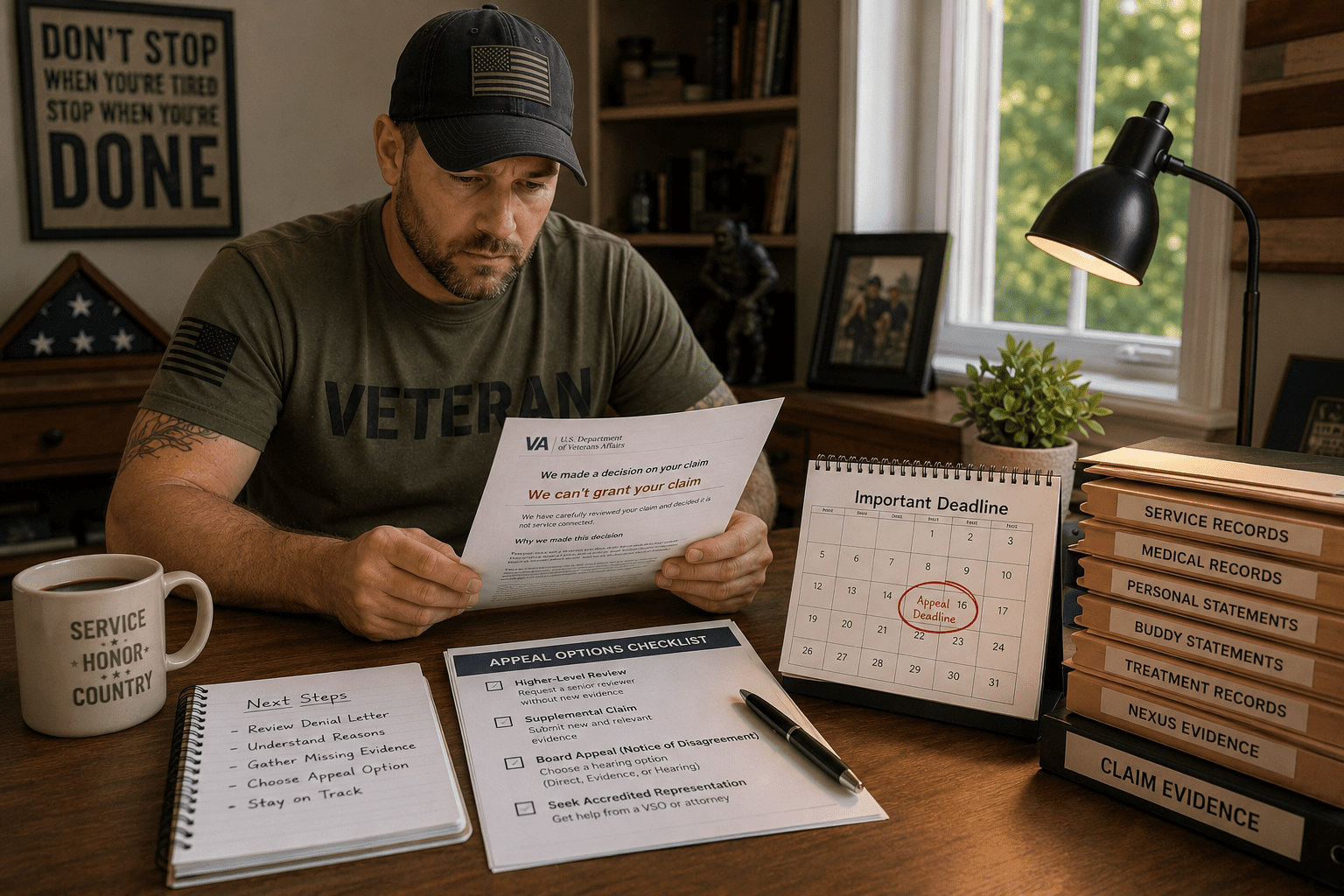
VA Disability Claim Denied? What to Do Next
VA disability claim denied what to do is one of the first questions veterans ask after opening a decision letter and seeing bad news. A denial can feel personal, but it is usually a signal that the VA did not see enough evidence, did not connect the evidence correctly, or rated the condition differently than expected.
VA Disability Claim Denied What to Do First?
Why VA Disability Claims Get Denied
VA disability claims get denied for many reasons. Sometimes the VA agrees that you have a condition but says the evidence does not connect it to service. Other times, the VA may grant service connection but assign a lower rating than your symptoms support.
Additionally, a denial can happen because key evidence never reached the file. Missing medical records, weak nexus evidence, unclear buddy statements, incomplete forms, or a confusing C&P exam can all affect the decision.
Common denial reasons include no current diagnosis, no service connection, no nexus, low rating evidence, or a missed exam or paperwork issue. Warrior Allegiance’s guide to what to do before your VA appeal deadline passes explains why veterans should understand the denial reason before choosing an appeal strategy.
Which VA Appeal Option Fits Your Denial Reason?
Once you know why the VA denied the claim, choose the review option that fits the problem. Do not pick a lane just because it sounds stronger.
| Denial problem | Best-fit option | New evidence? | Why it may fit | Watch out for |
|---|---|---|---|---|
| Missing medical records or nexus evidence | Supplemental Claim | Yes | Lets you add new and relevant evidence | Repeating old evidence may not help |
| VA ignored evidence already in the file | Higher-Level Review | No | A senior reviewer can review the prior decision | You cannot submit new evidence |
| Complex facts or repeated disagreement | Board Appeal | Depends on docket | A Veterans Law Judge can review the case | It may take longer |
| Appeal deadline already passed | New claim | Yes | Lets you restart the claim process | You may lose the earlier effective date |
| You are unsure why it was denied | Claim review help | N/A | Helps match the denial reason to the right path | Guessing can waste time |
Step 1: Read the Decision Letter Before You React
The VA decision letter is your roadmap. It usually lists the issue decided, the evidence reviewed, the favorable findings, the reasons for decision, and your appeal rights. Read those sections before choosing your next move.
Favorable findings are especially useful. If the VA already accepted that you have a diagnosis or that an in-service event occurred, you may not need to prove that part again. Instead, your next filing may need to focus on the missing link, such as a nexus letter or stronger medical records.
- The decision date. This starts the appeal-deadline clock.
- Evidence reviewed. This shows what the VA actually considered.
- Favorable findings. These are facts the VA accepted.
- Reasons for denial. This tells you what problem must be fixed.
- Appeal rights. This explains the available review options.
Step 2: Match the Denial Reason to the Right Review Lane
The best appeal option depends on the reason for denial. If the VA denied the claim because evidence was missing, a Supplemental Claim may be the most practical path. If the evidence was already there but the VA made a mistake, Higher-Level Review may make more sense.
However, some cases need a Board Appeal. This may apply when the facts are complex, the claim has been denied multiple times, or you want a Veterans Law Judge to review the case. Board Appeals can be useful, but they can also take longer, so the choice should be intentional.
- Denied for no diagnosis? Gather updated medical records.
- Denied for no nexus? Consider a stronger medical opinion.
- Denied despite evidence already submitted? Consider Higher-Level Review.
- Denied after complex or repeated disputes? Consider a Board Appeal.
- Denied with a low rating? Focus on rating criteria, symptoms, and functional impact.
Step 3: Gather Evidence That Answers the Denial
If the VA disability claim denied what to do question points to missing evidence, your next step is targeted proof. More pages do not automatically make a stronger claim. Better evidence answers the reason the VA denied the claim.
For service connection, useful evidence may include medical nexus letters, service records, buddy statements, private medical opinions, or records showing symptoms started during or soon after service. For a low rating, useful evidence may include updated treatment records, symptom logs, work-impact evidence, and statements about daily limitations.
- Updated medical records. Show diagnosis, treatment, severity, and ongoing symptoms.
- Nexus letters. Explain why a current condition is related to service or another service-connected disability.
- Buddy statements. Describe events, symptoms, and daily impact from people with firsthand knowledge.
- Private medical opinions. Add condition-specific reasoning from a qualified provider.
- C&P exam concerns. Show where an exam may have been incomplete or inconsistent.
- Work and functional evidence. Show missed work, accommodations, flare-ups, or daily limitations.
Additionally, Warrior Allegiance’s VA disability claims support resources can help veterans think through how evidence fits into the broader claim strategy.
Step 4: Protect the One-Year Appeal Deadline
One of the most important answers to VA disability claim denied what to do is this: protect your deadline. Veterans generally have one year from the date on the VA decision letter to choose a review option.
That deadline can affect your effective date. If you act within the appeal period and later win, you may be able to preserve the original claim date. If you miss the deadline, you may need to file a new claim and risk losing back pay tied to the earlier filing.
Therefore, write down the date immediately. Then build your appeal strategy around the deadline. If the date is close, do not wait for the situation to feel less stressful before taking action.
Still, do not rush blindly. The goal is to act in time and choose the right review option. A fast but mismatched appeal can create more delay.
Appealing denied VA claims →Step 5: Avoid Mistakes That Can Delay Your Appeal
A denial is frustrating. However, the wrong reaction can make the next review harder.
- Sending the same evidence again without a strategy. If the VA already reviewed it, repeating it may not fix the issue.
- Choosing Higher-Level Review when you need new evidence. HLR does not allow new evidence.
- Missing the one-year deadline. This can affect effective date and potential back pay.
- Ignoring favorable findings. These can narrow what you still need to prove.
- Using vague personal statements. Statements should address the exact denial reason.
- Assuming the denial means the claim is over. Many claims are strengthened after the right review path.
As a result, the best approach is careful and focused. Read the denial, identify the missing piece, and build the next filing around that gap.
How to appeal a denied VA claim →When Should You Get Help With a Denied VA Claim?
You may want help if the decision letter is confusing, the deadline is close, or the VA denied a claim you believe was supported by evidence. Help may also matter when your claim involves secondary service connection, multiple disabilities, conflicting C&P exams, or missing records.
What did the VA accept? Favorable findings may reduce what you still need to prove.
What did the VA reject? The reasons for decision show the real problem.
What evidence or review lane fits the issue? The appeal strategy should match the denial reason. If you are asking VA disability claim denied what to do because you are unsure where to begin, start with the decision letter. Then consider getting a claim review before choosing an appeal lane.
Frequently Asked Questions
Q1 VA disability claim denied what to do first? +
Q2 Can I appeal a denied VA disability claim? +
Q3 What is the best appeal option after a VA denial? +
Q4 How long do I have after a VA claim denial? +
Q5 What evidence helps after a VA disability claim denial? +
Get Help After a Denied VA Claim
VA disability claim denied what to do is easier to answer when you know why the VA said no. Do not guess. Read the decision letter, protect the deadline, identify the missing evidence, and choose the review path that fits the denial reason.