
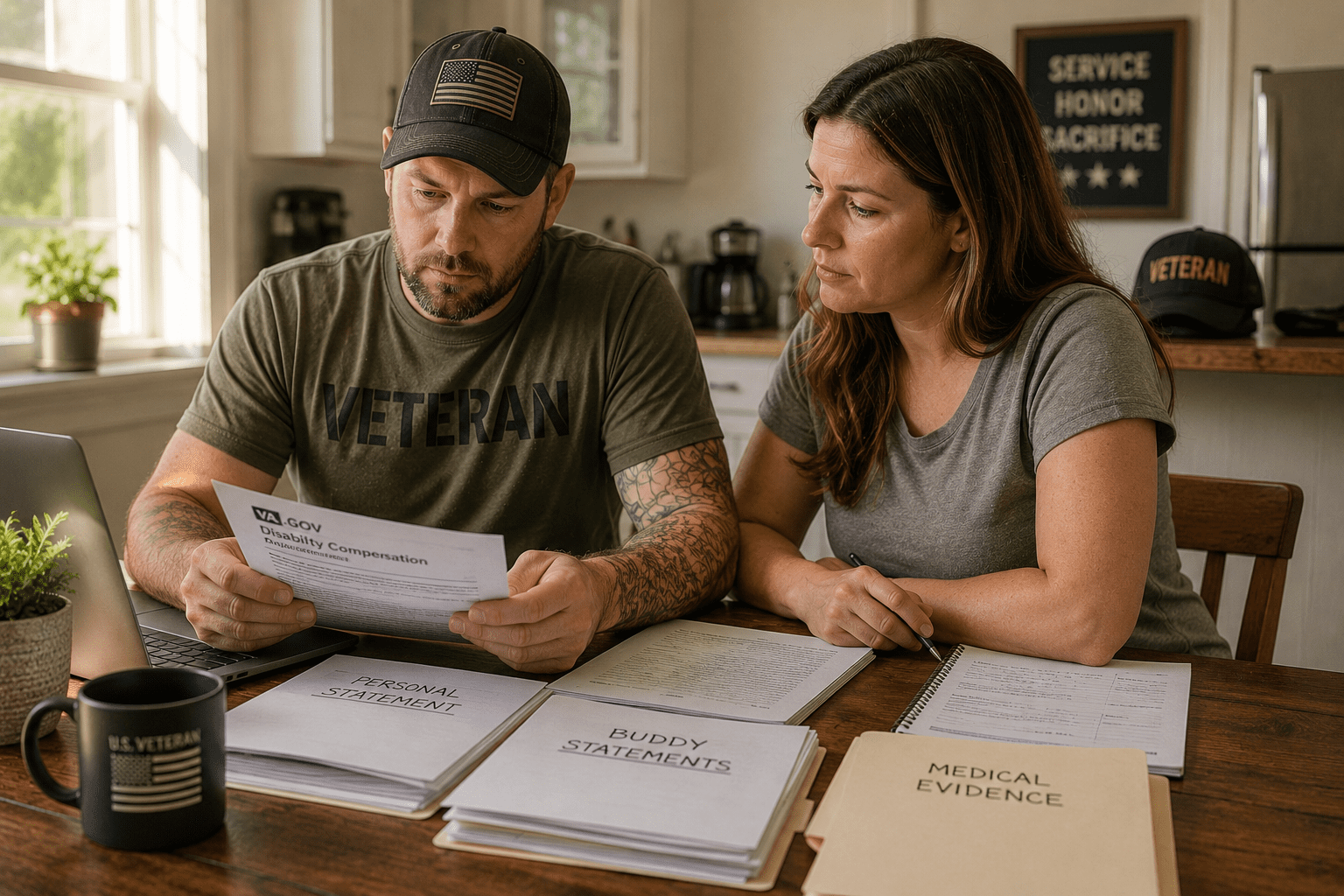
VA Buddy Statement Examples That Help Support Your Claim
VA buddy statement examples can help you understand how a strong lay statement should sound before you submit evidence with a VA disability claim. A buddy statement is not a medical opinion. Instead, it is a firsthand account from someone who saw what happened, noticed symptoms, or understands how your condition affects your daily life.
What Should VA Buddy Statement Examples Include?
Why Buddy Statements Matter in VA Disability Claims
Buddy statements matter because they give the VA context that records alone may miss. A service treatment record might show one clinic visit, but it may not describe the full incident, repeated strain, or how symptoms kept getting worse after service.
Additionally, many veterans served in environments where they pushed through pain, avoided sick call, or did not report symptoms right away. That does not mean the symptoms were not real. It means the claim may need extra evidence that explains the timeline.
A well-written statement can support what happened during service, what symptoms looked like over time, and how the condition affects daily life. For more context, review Warrior Allegiance’s guide to how buddy statements can strengthen VA claims.
VA Buddy Statement Examples at a Glance
The right writer depends on what your claim needs to prove. Use this table to match the statement type to the evidence gap.
| Statement type | Best writer | What it supports | Strong details | Avoid |
|---|---|---|---|---|
| Service event | Fellow service member | In-service injury, incident, or exposure | Date range, unit, location, what happened, what changed after | Guessing about diagnosis |
| Spouse statement | Husband, wife, or partner | Daily symptoms and functional impact | Sleep, pain, mood, chores, driving, work, social life | Medical conclusions |
| Family statement | Parent, sibling, or adult child | Before-and-after changes | Personality, mobility, memory, activity level, family interactions | Vague praise only |
| Coworker statement | Supervisor or teammate | Work limitations | Absences, reduced stamina, mistakes, accommodations, pain behavior | HR opinions or speculation |
| Personal statement | The veteran | Timeline and lived experience | What happened, symptoms, treatment, daily limits, flare-ups | Exaggeration or unrelated history |
VA Buddy Statement Examples From Fellow Service Members
Use this type of statement when another service member saw the in-service event, injury, or conditions that relate to your claim. For example, the writer may say they served with the veteran in a specific unit, personally witnessed an injury, and noticed problems with walking, lifting, sleeping, or concentration afterward.
Sample wording: “I served with [Veteran’s Name] in [unit] from [month/year] to [month/year]. During that time, I personally witnessed an incident where [he/she/they] injured [body part] while [briefly describe event]. After the incident, I noticed [specific symptoms or changes].”
This works because it stays focused on firsthand observation. It does not try to diagnose the veteran. Instead, it connects the event, the timeline, and the visible change.
VA Buddy Statement Examples From a Spouse or Family Member
A spouse statement can be powerful because it often shows the daily impact of a condition. Moreover, a spouse may see symptoms that never appear in a medical appointment. A good statement explains how often symptoms happen and how they affect home life.
Sample wording: “I am [Name], the spouse of [Veteran’s Name]. Since [Veteran’s Name] returned from service, I have noticed major changes in [sleep, pain, mood, memory, mobility, or social activity]. For example, [Veteran’s Name] wakes up several nights a week because of [symptom].”
Family members can also describe the before-and-after picture. In addition, they can explain changes in personality, activity level, memory, social behavior, or pain patterns that developed after service.
VA Buddy Statement Examples From a Coworker or Supervisor
Coworker statements can help when a condition affects job performance, attendance, focus, stamina, or physical duties. However, the writer should stick to work-related observations instead of giving medical opinions.
Sample wording: “I worked with [Veteran’s Name] at [workplace] from [month/year] to [month/year]. During that time, I personally observed [him/her/them] struggle with [specific task]. I also noticed [specific pattern], such as missed work, needing extra breaks, or showing visible pain.”
Specifically, this type of statement can explain functional impact in a real-world setting. It may also help show how symptoms affect earning capacity and routine responsibilities.
How to Write VA Buddy Statement Examples Step by Step
A strong statement does not need fancy language. In fact, plain language usually works better because it sounds natural and credible. First, identify the writer. Include the writer’s full name, relationship to the veteran, and how long they have known the veteran.
Second, explain what the writer personally observed. The statement should answer: What did you see? When did you see it? How often did it happen? Third, connect the observation to the claim with clear details about symptoms, limitations, or the event.
Finally, use the right form or submission method. VA lists VA Form 21-10210 as the Lay/Witness Statement form. You can also review Warrior Allegiance’s VA disability claims support resources for guidance on how evidence fits into the broader claim strategy.
VA disability claims support →How to Choose the Best Buddy Statement for Your Claim
The best buddy statement depends on the missing piece in your evidence. If your service records do not clearly show an event, a fellow service member may be the best writer. If your rating depends on severity, a spouse or coworker may help more.
What does my claim need to prove? If you need to prove an in-service event, choose someone who saw or knew about that event when it happened.
Who has firsthand knowledge? The strongest writer is not always the highest-ranking person. Instead, it is the person who can describe real observations clearly.
What daily impact is missing from my records? If medical notes do not show how often symptoms happen, ask someone who sees the pattern. As a result, many veterans use more than one statement.
Buddy statement claim guide →Frequently Asked Questions
Q1 What are VA buddy statement examples? +
Q2 Who can write a VA buddy statement? +
Q3 Should a buddy statement include medical opinions? +
Q4 How long should a VA buddy statement be? +
Q5 Can I submit more than one buddy statement? +
Get Help Strengthening Your VA Disability Claim
VA buddy statement examples are useful, but the strongest statement is the one that matches your actual evidence gap. A good statement should explain what happened, what changed, and how the condition affects your life now. Warrior Allegiance helps veterans organize evidence and understand where lay statements may support the bigger picture.