
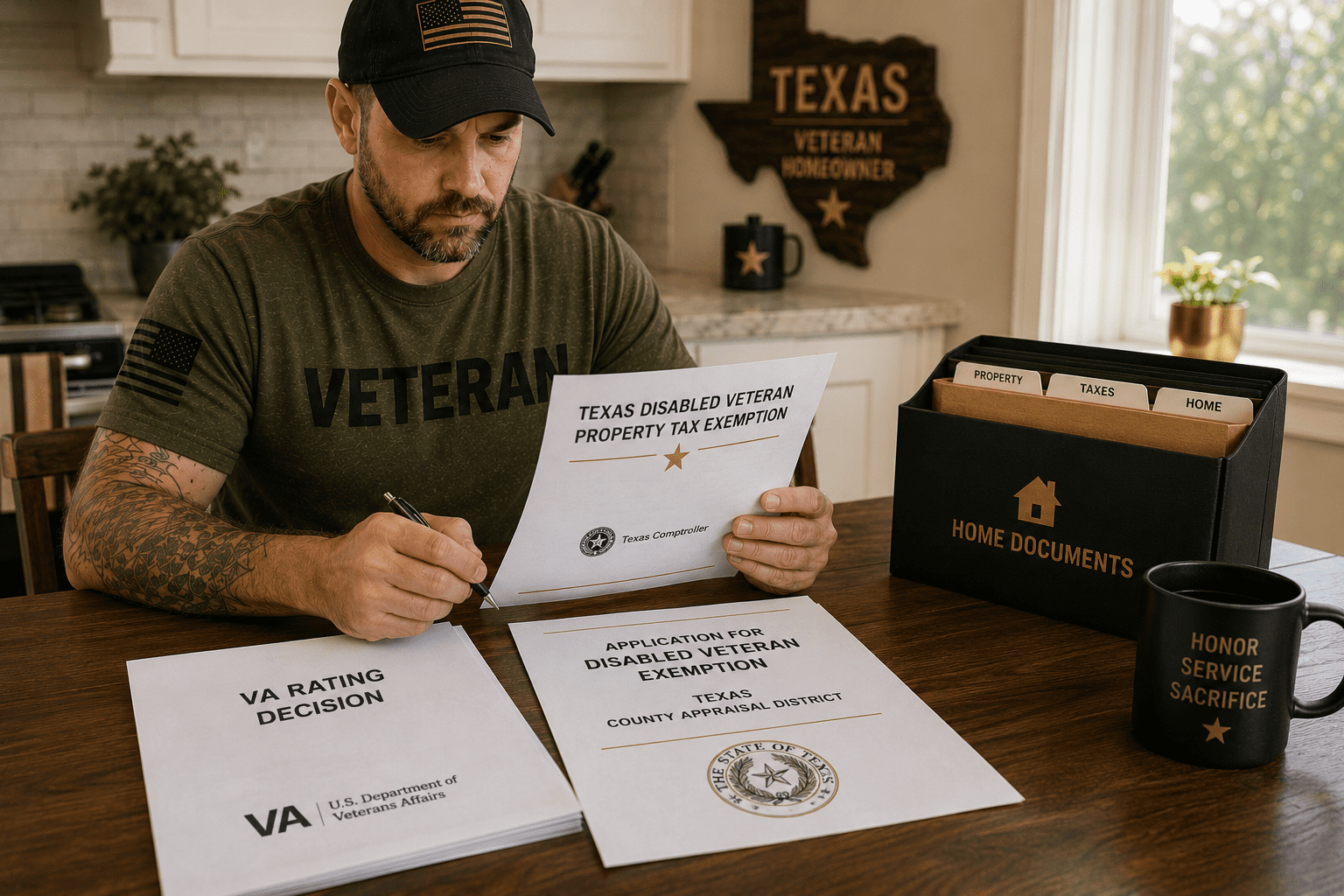
Texas Veteran Property Tax Exemption 2026: What Veterans Should Know
Texas veteran property tax exemption 2026 questions usually start when a disabled veteran receives a VA rating, buys a home, or realizes their property tax bill may be reduced. In Texas, qualifying disabled veterans may receive a partial exemption or, in some cases, a full residence homestead exemption.
Who Qualifies for the Texas Veteran Property Tax Exemption in 2026?
Why the Texas Veteran Property Tax Exemption Matters
The Texas veteran property tax exemption matters because property taxes can be one of the largest yearly costs for homeowners. For disabled veterans, reducing taxable value can free up money for medical care, family needs, home repairs, transportation, or long-term planning.
Additionally, many veterans do not realize that property tax exemptions are not usually applied just because VA awarded a disability rating. The veteran often needs to file the right form with the county appraisal district and include supporting documents.
Warrior Allegiance’s guide to how VA disability ratings work can help veterans understand why rating percentage matters before they start matching that rating to state and local benefits.
Texas Disabled Veteran Exemption by Rating Level
Use this table as a practical starting point. Always confirm current forms and local procedures with the county appraisal district before filing.
| VA rating or status | Possible exemption | Property type | Proof to gather | Where to file |
|---|---|---|---|---|
| 10% to 29% disabled | Partial exemption amount based on rating | One qualifying property | VA award letter or rating proof, ownership details, ID | County appraisal district |
| 30% to 49% disabled | Higher partial exemption amount | One qualifying property | VA rating proof, property account details, Texas residency proof | County appraisal district |
| 50% to 69% disabled | Higher partial exemption amount | One qualifying property | VA disability documentation, deed or ownership record, ID | County appraisal district |
| 70% to 99% disabled | Higher partial exemption amount | One qualifying property | VA rating letter, property records, local application | County appraisal district |
| 100% disabled or qualifying unemployability | Full residence homestead exemption may apply | Residence homestead | VA proof of 100% or qualifying status, homestead application details | County appraisal district |
What Changes for 100% Disabled Veterans in Texas?
For many veterans, the biggest question is whether Texas offers a full property tax exemption for 100% disabled veterans. In many cases, a qualifying 100% disabled veteran may receive a full exemption from property taxes on the veteran’s residence homestead.
However, “100%” should be documented clearly. Veterans should review whether the VA decision shows a 100% service-connected rating, permanent and total status, or individual unemployability where applicable. County appraisal districts may need specific documents, and local review can vary.
Also, the full exemption is generally tied to the residence homestead. That means the property must usually be the veteran’s primary home, not a rental, vacation property, or unrelated investment property.
How Partial Disabled Veteran Exemptions Work
Not every disabled veteran has a 100% rating. However, Texas still provides partial disabled veteran exemptions based on disability percentage. These exemptions reduce a portion of the property’s taxable value rather than eliminating all property taxes.
For example, a veteran with a lower VA disability rating may qualify for a smaller exemption amount, while a veteran in a higher rating band may qualify for a larger exemption amount. The exact amount and application should be confirmed through the Texas Comptroller and the local appraisal district.
This is why VA rating documentation matters. A veteran should gather the rating letter or other official proof showing the service-connected disability percentage before applying.
Surviving Spouse and Family Rules
Texas veteran property tax exemption 2026 planning can also matter for surviving spouses and families. Texas law may allow certain surviving spouses or surviving children to qualify for disabled veteran or survivor exemptions when requirements are met.
Because survivor rules can depend on ownership, residence, remarriage status, disability status, and timing, families should keep VA decision letters, death certificates if relevant, marriage records, and property documents organized.
Additionally, a surviving spouse may need to file with the county appraisal district and provide proof that the legal requirements still apply. Therefore, families should not assume a prior exemption automatically transfers without paperwork.
Spouse and dependent benefits →How to Apply for the Texas Veteran Property Tax Exemption in 2026
The Texas veteran property tax exemption 2026 application process usually starts with the county appraisal district, not VA. VA provides the rating documentation, but the local appraisal district processes the property tax exemption.
Start by finding your county appraisal district’s exemption page. Then locate the disabled veteran or survivor exemption application. The Texas Comptroller’s Form 50-135 is commonly used for disabled veteran or survivor exemption requests, but local instructions may explain how to submit it.
Next, gather supporting documents. These may include VA rating proof, identification, property ownership records, residence homestead information, and any county-specific forms or instructions. Finally, keep a copy of everything submitted and confirm receipt with the appraisal district.
Documents Veterans Should Gather Before Filing
Before applying, veterans should build a simple property tax exemption folder. This prevents delays and makes county follow-up easier.
- VA disability rating letter. This shows the rating percentage or qualifying status.
- Proof of Texas residency. Local appraisal districts may request identification or address proof.
- Property ownership records. Deed information, appraisal district account number, or closing documents may help.
- Residence homestead documents. For full homestead exemptions, the home must generally be the qualifying residence.
- Survivor documents. Spouses may need marriage records, death records, prior exemption proof, or remarriage-status confirmation.
- County application forms. Use the form and instructions required by the appraisal district where the property is located.
Additionally, veterans should keep the latest VA decision letter handy. If the rating changed recently, the county may need updated documentation.
Common Mistakes Texas Veterans Should Avoid
Small mistakes can delay or reduce the Texas veteran property tax exemption 2026 benefit. Fortunately, many are preventable.
- Assuming the exemption is automatic. VA ratings do not automatically update county property tax records.
- Filing with the wrong office. Disabled veteran exemption forms are generally filed with the county appraisal district.
- Using old rating proof. If the rating changed, provide current VA documentation.
- Confusing partial and full exemptions. A lower disability rating may reduce taxable value but may not eliminate the full bill.
- Ignoring homestead rules. A full 100% disabled veteran exemption generally depends on a residence homestead.
- Missing survivor requirements. Surviving spouses should confirm remarriage, residence, ownership, and timing rules.
As a result, veterans should verify the right exemption type before filing and check their property tax account after approval.
How VA Ratings Connect to Texas Property Tax Benefits
A VA disability rating can affect more than monthly compensation. In Texas, it can also help determine property tax exemption eligibility. Therefore, an accurate VA rating may matter for both federal compensation and state-level property tax savings.
If a veteran believes the VA rating is too low, it may affect the exemption level available in Texas. However, the county appraisal district does not change the VA rating. The veteran must address rating issues through VA claims, increases, appeals, or supporting evidence.
Warrior Allegiance helps veterans understand how rating decisions can affect broader benefits. If your current rating does not match your symptoms, review the VA decision before assuming your Texas exemption options are fixed.
VA disability rating levels →Frequently Asked Questions
Q1 Who qualifies for the Texas veteran property tax exemption 2026? +
Q2 Do 100% disabled veterans pay property taxes in Texas? +
Q3 Where do I file for a Texas disabled veteran property tax exemption? +
Q4 What form is used for the Texas disabled veteran exemption? +
Q5 Can a surviving spouse keep a Texas veteran property tax exemption? +
Get Help Understanding Your VA Rating and Texas Benefits
Texas veteran property tax exemption 2026 rules can save qualifying veterans and families real money, but the path depends on rating proof, homestead status, county filing, and current documentation.