
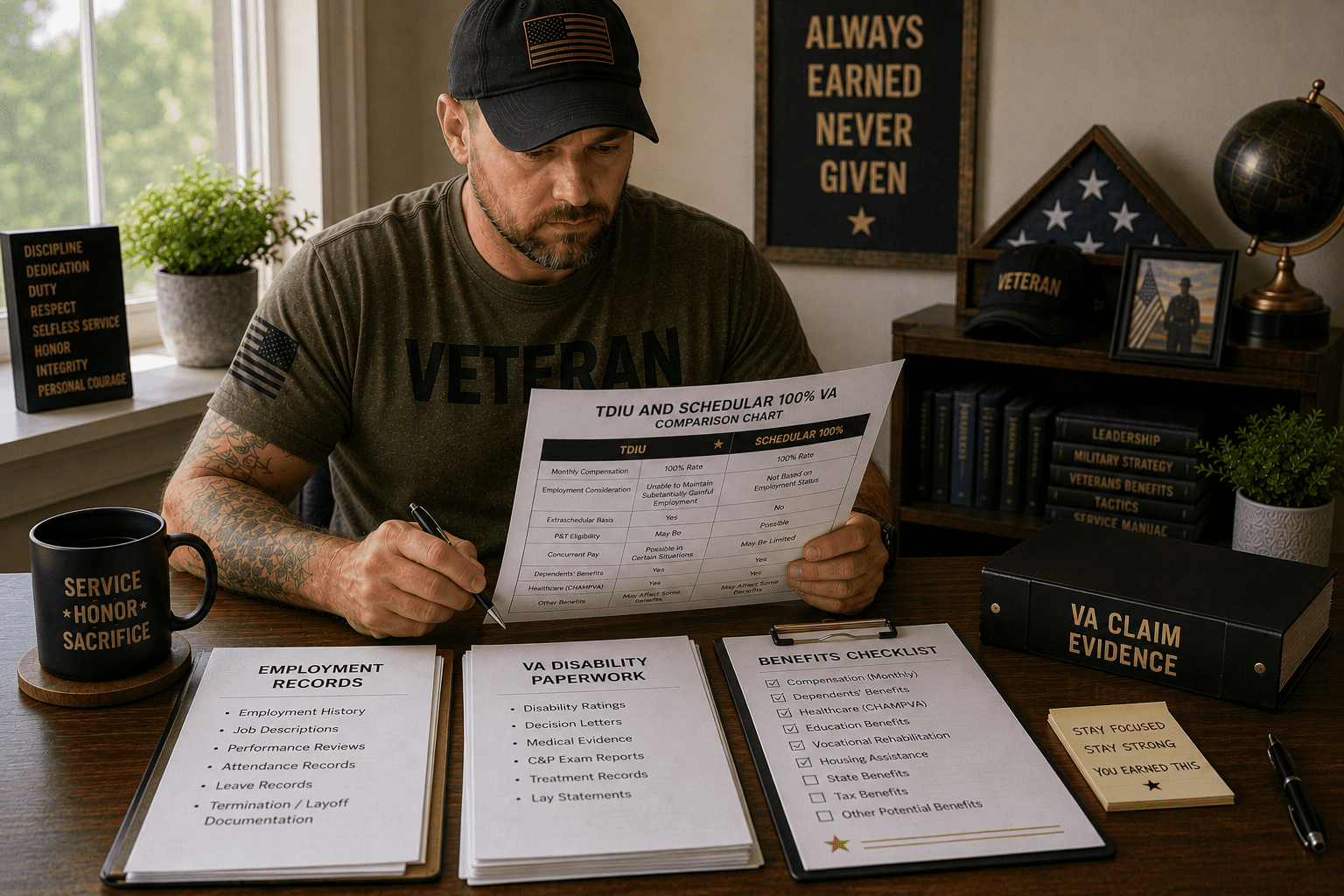
TDIU vs Schedular 100 Percent VA: What Veterans Should Know
TDIU vs schedular 100 percent VA is one of the most important comparisons for veterans who cannot work because of service-connected disabilities. Both paths may pay at the 100% compensation rate, but they are not the same.
Is TDIU the Same as Schedular 100% VA Disability?
Why Veterans Compare TDIU and Schedular 100%
Veterans compare TDIU and schedular 100% because the monthly pay can look similar, but the rules behind the benefit can feel very different. A veteran at 70%, 80%, or 90% may be unable to work and wonder whether TDIU is the bridge to 100% compensation. Meanwhile, another veteran may be close to a schedular 100% rating and unsure whether to pursue an increase instead.
Additionally, work rules are a major concern. Veterans often ask whether they can work with TDIU, whether part-time work counts, whether sheltered employment matters, and whether a schedular 100% rating allows more employment flexibility.
Warrior Allegiance’s TDIU comprehensive guide explains that Individual Unemployability focuses on whether service-connected disabilities make it difficult or impossible to maintain substantially gainful employment.
TDIU vs Schedular 100% VA at a Glance
Use this table as a practical comparison. It does not replace VA rules, but it helps veterans understand the main differences.
| Comparison point | TDIU | Schedular 100% VA | Why it matters | Watch out for |
|---|---|---|---|---|
| Pay rate | Paid at the 100% compensation rate | Paid at the 100% compensation rate | Monthly pay may be similar | Same pay does not mean same rules |
| Basis | Unemployability due to service-connected disabilities | Rating schedule totals 100% | TDIU focuses on work capacity | Diagnosis alone is not enough |
| Work rules | Substantially gainful work can threaten eligibility | Work may be allowed unless other rules apply | Employment is a key difference | Marginal or sheltered work can be complicated |
| Evidence | Work history, medical opinions, failed jobs, limitations | Medical severity under rating criteria | Evidence strategy differs | Filing the wrong path can delay benefits |
| P&T status | May or may not be permanent and total | May or may not be permanent and total | Family benefits may depend on P&T | Do not assume 100% pay means P&T |
How TDIU Works
TDIU stands for Total Disability Individual Unemployability. It exists for veterans whose service-connected disabilities prevent them from maintaining substantially gainful employment, even if their combined rating is below 100%.
For example, a veteran may have a 70% PTSD rating and be unable to maintain steady work because of panic, anger, isolation, poor concentration, and difficulty adapting to stress. Another veteran may have severe back and nerve conditions that prevent sitting, standing, lifting, or walking long enough to keep a job.
In a TDIU claim, the VA is not only asking whether the veteran has symptoms. It is asking whether service-connected conditions prevent substantially gainful employment based on education, work history, limitations, and medical evidence.
How Schedular 100% VA Disability Works
A schedular 100% VA rating means the veteran’s service-connected conditions meet the rating schedule requirements for total compensation. This may happen through one condition rated at 100% or through combined ratings that reach 100% under VA math.
Unlike TDIU, schedular 100% is not automatically based on unemployability. The rating is based on the severity of service-connected conditions under the VA rating criteria. Therefore, the evidence usually focuses on symptoms, medical findings, functional loss, frequency, severity, and rating-code requirements.
For some veterans, schedular 100% may offer more employment flexibility than TDIU. However, every case depends on the condition, rating basis, permanence, and whether special rules apply.
Work Rules: TDIU vs Schedular 100 Percent VA
Work rules are often the biggest difference in TDIU vs schedular 100 percent VA comparisons. TDIU is based on the idea that service-connected disabilities prevent substantially gainful employment. Therefore, returning to gainful work can put TDIU at risk.
However, not all work is treated the same. Marginal employment, protected work environments, family businesses, or sheltered work may be evaluated differently. The facts matter. The VA may look at income, accommodations, job duties, consistency, and whether the work is truly competitive employment.
By contrast, a schedular 100% rating does not usually depend on proving unemployability. A veteran with schedular 100% may be able to work, although certain conditions or benefit types can still create special issues. Veterans should not assume one rule fits every case.
Working with VA disability →Evidence Needed for TDIU
TDIU evidence should show why the veteran cannot maintain substantially gainful employment because of service-connected disabilities. The strongest evidence connects medical symptoms to work limitations.
- VA Form 21-8940. This application asks about disability, work history, education, training, and when the veteran became too disabled to work.
- Medical opinions. A doctor, psychologist, or vocational expert may explain how service-connected conditions limit work capacity.
- Employment history. Failed jobs, reduced hours, terminations, accommodations, or missed work can show the real pattern.
- Lay statements. Family, coworkers, supervisors, or friends can describe visible work-related limitations.
- Treatment records. Mental health notes, pain records, medication changes, imaging, or specialist care can show severity over time.
- Functional details. Explain limits with sitting, standing, lifting, concentration, attendance, reliability, stress tolerance, or social interaction.
Additionally, veterans should separate service-connected limitations from non-service-connected issues when possible. TDIU depends on service-connected disabilities, so the evidence should keep that focus clear.
Evidence Needed for Schedular 100%
Schedular 100% evidence is usually different. Instead of proving unemployability, the veteran must show that service-connected conditions meet the rating criteria for 100% or combine to 100% under VA math.
For example, mental health ratings may focus on occupational and social impairment. Musculoskeletal ratings may focus on range of motion, ankylosis, flare-ups, pain, weakness, or functional loss. Respiratory, cardiac, neurological, digestive, and other conditions each have their own criteria.
Therefore, veterans seeking schedular 100% should review the rating decision and identify what evidence is missing. If the current rating is too low, the next step may be an increased-rating claim, supplemental claim, or appeal depending on timing and evidence.
How VA disability ratings work →Permanent and Total Status
Permanent and total status is another area where veterans get confused. TDIU can be permanent and total, but it is not always permanent. A schedular 100% rating can also be permanent and total, but it is not automatic.
This matters because P&T status may affect family benefits, dependents’ education benefits, CHAMPVA eligibility, and future review expectations. Therefore, veterans should read the decision letter carefully. Do not assume that being paid at the 100% rate automatically means the rating is permanent and total.
If the VA decision does not clearly show P&T status, veterans may need to review the code sheet, benefit letters, or decision language to understand whether future exams may occur.
How to Choose the Right VA Path
Start by asking what problem you are trying to solve. If your service-connected disabilities prevent substantially gainful employment, TDIU may fit. If your conditions meet the rating schedule for 100%, schedular 100% may fit. If your rating is too low because the VA missed evidence, an appeal or supplemental claim may be better.
Next, review your work history. Have you stopped working because of service-connected conditions? Are you working only marginal hours? Do you work in a protected setting? Have you lost jobs or needed unusual accommodations? These details can point toward or away from TDIU.
Finally, compare the evidence you have. TDIU needs employability evidence. Schedular 100% needs rating-criteria evidence. The strongest strategy depends on what your records can prove.
Common Mistakes Veterans Should Avoid
TDIU and schedular 100% claims can be weakened by choosing the wrong path or misunderstanding the rules.
- Assuming TDIU and schedular 100% are identical. Same pay rate does not mean same eligibility.
- Ignoring work rules. Substantially gainful employment can create TDIU problems.
- Filing TDIU without work evidence. The VA needs employment history and functional limitations.
- Assuming P&T automatically applies. Permanent and total status must be confirmed.
- Blaming non-service-connected issues. TDIU must focus on service-connected disabilities.
- Overlooking secondary conditions. Related disabilities may support ratings or unemployability when properly documented.
As a result, veterans should review the rating decision, work history, medical records, and long-term goals before deciding.
Frequently Asked Questions
Q1 Is TDIU vs schedular 100 percent VA the same thing? +
Q2 Can you work with TDIU? +
Q3 Can you work with a schedular 100% VA rating? +
Q4 Does TDIU pay the same as 100% VA disability? +
Q5 Is TDIU permanent and total? +
Get Help Comparing TDIU and 100% VA
TDIU vs schedular 100 percent VA decisions can shape compensation, work options, family planning, and long-term claim strategy. The key is understanding that the pay rate may be similar, but the rules are not.