
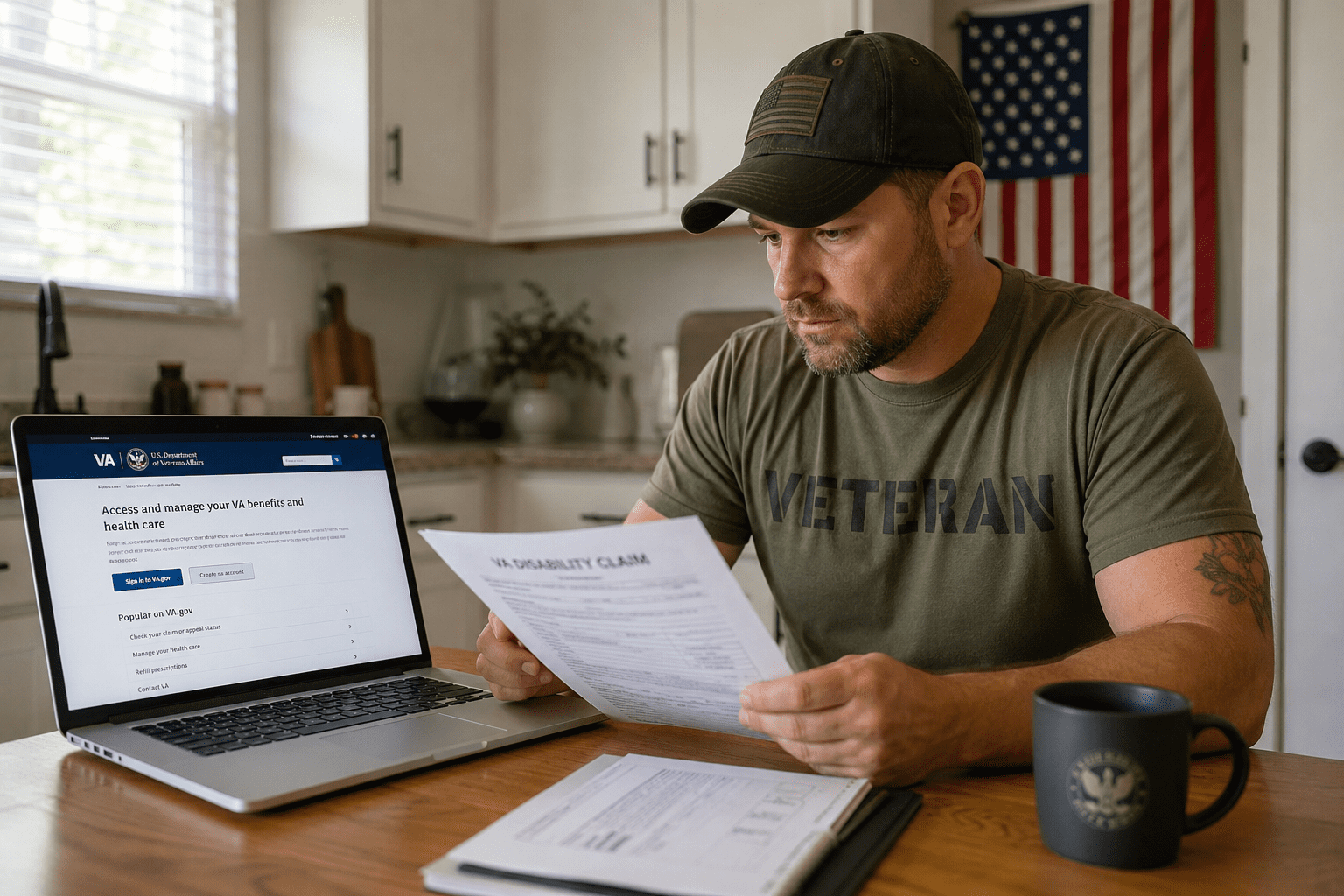
How to File a VA Disability Claim for the First Time in 2026: A Step-by-Step Guide for Veterans
If you are trying to figure out how to file a VA disability claim for the first time in 2026, you are not alone — and you are not too late. Every year, thousands of veterans leave significant tax-free compensation on the table simply because the process feels too complicated, too slow, or too easy to get wrong. It is none of those things when you know what to expect. This guide walks you through every step, from the five-minute move that protects your back pay all the way to the exam that makes or breaks your rating.
How to File a VA Disability Claim for the First Time in 2026 — Quick Answer
Why First-Time VA Claimants Leave Money on the Table
Most first-time claimants do not lose because they lack a qualifying condition. They lose because of evidence gaps, missed deadlines, and one overlooked form that could have protected months — sometimes years — of back pay.
The VA evaluates every claim against three requirements. First, you need a current diagnosis. Second, you need evidence of an event, injury, or illness during active service. Third, you need a documented medical link connecting the two. Miss any one of those three and your claim will likely be denied — not because you were not injured, but because the paperwork does not prove it yet.
Additionally, the VA currently averages 125 days to process a standard claim. That timeline makes the very first step — one most veterans skip entirely — worth thousands of dollars before you ever touch the main form. For official VA eligibility standards, see the VA's disability eligibility page.
VA Disability Claim Filing Methods at a Glance
Not every filing method works equally well for every veteran. The table below compares your options so you can choose the path that fits your situation best.
| Method | How It Works | Cost | Best For | Processing Speed |
|---|---|---|---|---|
| Online via VA.gov | File VA Form 21-526EZ directly through the VA portal | Free | Veterans with records ready who are comfortable online | Fastest — also auto-creates Intent to File |
| Mail or In-Person | Paper form sent to regional office or dropped off in person | Free | Veterans without reliable internet access | Slower — no instant confirmation |
| VSO Assistance | Free help from DAV, VFW, or American Legion accredited reps | Free | First-time filers who want guided support at no cost | Varies by VSO caseload |
| Guided Claim Service | Expert team reviews evidence, builds nexus, and files for you | No upfront fee | Veterans who want the highest possible approval odds | Depends on evidence completeness |
| BDD Program | File 180–90 days before separation from active duty | Free | Active duty veterans separating in the next 6 months | Faster post-separation decision |
How Do You File a VA Disability Claim for the First Time in 2026?
Filing your first VA disability claim involves six steps. Follow them in order and you protect both your eligibility and your effective date — the date that determines how far back your compensation goes.
Understanding Your VA Disability Rating After You File
Once the VA processes your claim, it assigns a disability rating from 0% to 100% in 10% increments. That rating determines your monthly tax-free compensation. For 2026, the VA increased rates by 2.8%, effective December 1, 2025.
How VA Math Actually Works
Here is what surprises most first-time claimants: the VA does not simply add ratings together. If you file for multiple conditions, the VA uses "whole person" math — each additional rating applies to your remaining healthy percentage, not your original 100%. For example, a 50% rating plus a 30% rating does not equal 80%. Under VA math, it equals 65%, which rounds to that tier. Understanding this early helps you decide which conditions are worth filing together on your first claim.
Additionally, at 30% or higher, you receive extra monthly compensation for qualifying dependents. At 100%, you may qualify for Chapter 35 education benefits for dependents and a VA home loan funding fee exemption.
What a 0% Rating Still Gives You
A 0% service-connected rating pays no monthly compensation — but it still matters. It establishes the official link between your condition and your service, which means you can file for an increase if the condition worsens, you qualify for VA healthcare related to that condition, and it supports future secondary claims. Many veterans skip filing for conditions they assume will rate at 0%, leaving that service connection — and all future value attached to it — permanently unclaimed.
The Nexus Letter — The Evidence Most First-Time Filers Miss
A nexus letter is a written medical opinion from a licensed physician stating that your disability is "at least as likely as not" caused or aggravated by your military service. It is the single most commonly missing piece of evidence in denied first-time VA disability claims — and the single most effective addition to a Supplemental Claim after a denial.
You need a nexus letter when your service treatment records do not clearly document your condition, when your condition developed or worsened after separation, or when the VA's own examiner has previously concluded your disability is not service-connected. Furthermore, for chronic conditions — like sleep apnea secondary to PTSD, or back pain secondary to a knee injury — a nexus letter is often the only evidence that establishes the legal connection the VA requires. Without it, the VA rates each condition in isolation and misses the combined picture entirely.
Review Common VA Disabilities and Secondary Connections →How to Choose the Right Path for Your First VA Disability Claim
Not every veteran's situation is the same. Use these questions to identify the approach that fits your specific circumstances.
Do your service treatment records clearly document your condition?
If yes, filing online through VA.gov with an FDC is straightforward. If no, prioritize getting a nexus letter from a physician before submitting — otherwise you are likely setting up a denial that requires a Supplemental Claim to fix later.
Are you still on active duty within 180–90 days of separation?
The Benefits Delivery at Discharge (BDD) program lets you file before you leave service, which typically produces a faster post-separation rating decision. Moreover, filing through BDD can establish your effective date before your last day of service.
Have you filed before and been denied?
A denial is not the end. Supplemental Claims allow you to submit new and relevant evidence not previously considered. A Higher-Level Review asks a senior VA official to reexamine your case for clear errors. Most successful reversals come from Supplemental Claims paired with strong nexus letters.
Do you want the highest possible approval odds on your first attempt?
Working with a guided claim service — one that reviews your evidence, identifies gaps, and builds a nexus strategy before submission — significantly reduces the most common reasons first-time claims are denied. Warrior Allegiance offers a free consultation with no upfront fees and a 90%+ approval rate.
Frequently Asked Questions — How to File a VA Disability Claim for the First Time in 2026
Q1 How do I file a VA disability claim for the first time in 2026? +
Q2 What is the Intent to File and why does it matter so much? +
Q3 What evidence does the VA need for a first-time disability claim? +
Q4 How long does a first-time VA disability claim take in 2026? +
Q5 What happens if my first-time VA disability claim is denied? +
You Served. You Earned This. Let Warrior Allegiance Help You Claim It.
Knowing how to file a VA disability claim for the first time in 2026 is the difference between leaving compensation behind and claiming every dollar your service earned. The process has structure — and when you follow it correctly, with complete evidence and a clear nexus, the system works. Warrior Allegiance is a veteran-owned organization based in El Paso, Texas, with a 90%+ approval rate, no upfront fees, and a team of administrative specialists and medical professionals who have guided veterans through every step of this process since 2021. If you are rated 90% or below, or filing for the first time, start with a free consultation today.