
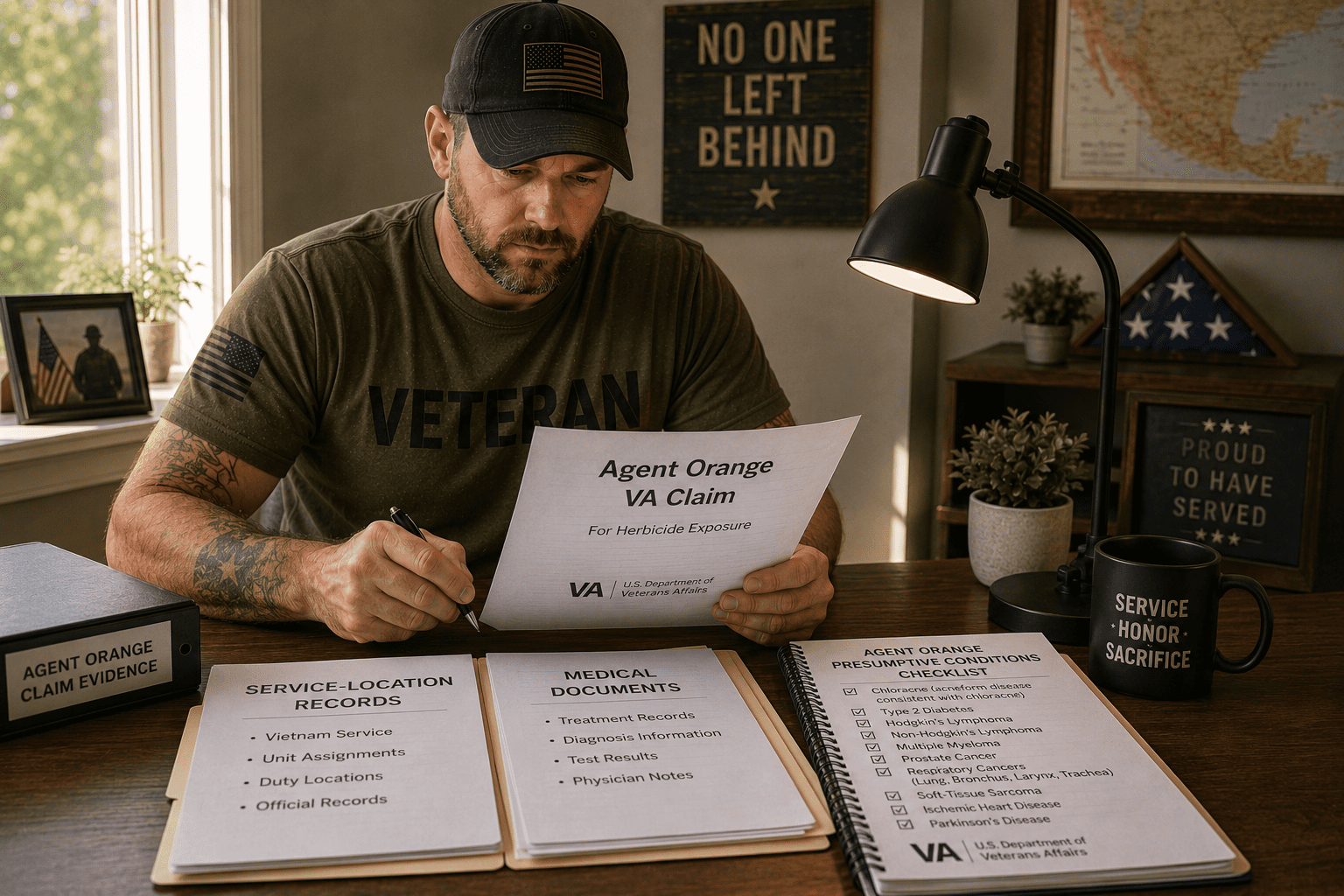
Agent Orange VA Claim 2026 Presumptive: What Veterans Should Know
Agent Orange VA claim 2026 presumptive rules can help veterans understand whether the VA may presume their illness is connected to herbicide exposure. That presumption matters because it can reduce the burden of proving a direct medical link, but it does not remove every evidence requirement.
Who Qualifies for an Agent Orange VA Claim 2026 Presumptive Review?
Why Agent Orange Presumptive Rules Still Matter in 2026
Agent Orange presumptive rules still matter in 2026 because many veterans were denied years ago under older evidence standards or incomplete exposure rules. Some veterans never filed because they assumed they did not qualify. Others filed without enough proof of location, diagnosis, or claim theory.
Additionally, toxic exposure rules have changed over time. That means a prior denial may deserve another look if the veteran’s condition, service location, or medical evidence now fits current VA guidance. This is especially important for veterans who served in areas beyond the most commonly discussed Vietnam in-country exposure scenarios.
Warrior Allegiance’s guide to Agent Orange and toxic exposure benefits explains why veterans should review exposure history, presumptive conditions, and compensation options carefully.
Agent Orange Presumptive Eligibility by Service Location
Use this table as a starting point. It can help veterans organize service records before filing or refiling a claim.
| Service location | Possible timeframe | What VA may review | Helpful proof | Watch out for |
|---|---|---|---|---|
| Vietnam in-country service | Vietnam War era service | Boots-on-ground service or qualifying inland waterways | DD214, personnel records, deployment history | Assuming vague Vietnam references are enough |
| Blue Water Navy | Qualifying offshore service | Ship location within recognized waters | Ship logs, deck logs, unit history, personnel file | Missing ship-name or date details |
| Korean DMZ | Specific qualifying period near the DMZ | Unit location and timeframe | Unit records, personnel file, orders | Claiming Korea service without DMZ link |
| Thailand bases | Qualifying duties or base exposure facts | Base location, duties, perimeter exposure evidence | Performance records, MOS, lay statements | Weak description of actual exposure |
| Other covered sites | Guam, Johnson Atoll, or other recognized exposure locations | Matching service period and location | Personnel records, travel orders, medical records | Using old location rules only |
What Conditions Are Agent Orange Presumptive in 2026?
An Agent Orange VA claim 2026 presumptive review starts with the diagnosis. VA-recognized herbicide-related conditions may include cancers, metabolic conditions, heart disease, neurologic conditions, and other illnesses on the current presumptive list.
Examples often associated with Agent Orange presumptions include Type 2 diabetes, ischemic heart disease, Parkinson’s disease, prostate cancer, bladder cancer, chronic B-cell leukemias, Hodgkin’s disease, non-Hodgkin’s lymphoma, multiple myeloma, respiratory cancers, AL amyloidosis, peripheral neuropathy, hypothyroidism, hypertension, monoclonal gammopathy of undetermined significance, and others listed by VA.
However, the exact diagnosis matters. For example, heart problems is not the same as a documented diagnosis of ischemic heart disease. Cancer is not enough without the specific cancer type, medical records, and diagnosis history.
What Evidence Supports an Agent Orange VA Claim?
Agent Orange claims usually need two evidence tracks: exposure eligibility and medical diagnosis. Presumptive service connection can help with the connection between the two, but the VA still needs a clear file.
- DD214 and service personnel records. These can show dates, branch, units, duty stations, ships, or deployment history.
- Medical diagnosis. The VA needs evidence of a current diagnosed condition.
- Treatment records. VA and private records can show severity, history, and ongoing care.
- Ship or unit records. These may help Blue Water Navy, Korea DMZ, Thailand, Guam, or other location-based claims.
- Lay statements. Personal or buddy statements may help explain duties, perimeter work, travel, or symptoms.
- Prior VA decisions. Old denials can show exactly what the VA found missing.
Additionally, veterans should match evidence to the claim theory. A Blue Water Navy claim may need ship location evidence. A Thailand perimeter-exposure claim may need duty records and credible descriptions of where the veteran worked.
How to File an Agent Orange VA Claim in 2026
If you believe your condition is presumptive, start by confirming the diagnosis. Use medical records, lab results, pathology reports, imaging, cardiology records, oncology records, or specialist notes as needed.
Next, confirm your qualifying service. Gather your DD214, personnel file, unit history, ship records, travel orders, or other evidence showing where and when you served.
Then connect the claim clearly. If your condition is on the presumptive list and your service location qualifies, the claim should make that easy to see. If the condition is not presumptive, you may still file, but you should expect to submit stronger medical evidence and a service-connection argument.
VA presumptive conditions guide →What If Your Condition Is Not on the Presumptive List?
A condition not appearing on the presumptive list does not always mean the claim is impossible. VA guidance says veterans can file a claim for an illness not on the list, but they will need to provide more evidence that the condition is related to service.
That evidence may include a medical nexus opinion, research-supported reasoning, treatment history, exposure documentation, and lay statements. However, these claims are usually more evidence-heavy because the VA is not automatically presuming the connection.
Therefore, veterans should be careful with unsupported filing. If your condition is not listed, first identify the service exposure, the diagnosis, and the medical theory that links them. Then build the claim around that gap instead of simply saying Agent Orange caused it.
Toxic exposure VA claim support →What If an Older Agent Orange Claim Was Denied?
Many veterans filed Agent Orange claims before rules expanded or before they had strong proof. If an older claim was denied, start with the prior decision letter. The denial reason tells you what needs to change.
For example, the VA may have denied the claim because there was no diagnosis, no recognized exposure location, no proof of duty near a qualifying area, or no medical connection for a non-presumptive illness. Each reason requires a different strategy.
Then compare the old denial to current 2026 guidance. If the condition, location, or evidence rules now support the claim better, you may have a stronger filing path. However, do not resubmit the same evidence without addressing the original problem.
Common Mistakes in Agent Orange VA Claims
An Agent Orange claim can still be delayed or denied if the evidence is vague. Presumptive rules help, but they do not fix an incomplete file.
- Using broad condition names. The VA needs the exact diagnosis, not just cancer or heart issues.
- Missing service-location proof. Location and timeframe often drive herbicide exposure eligibility.
- Ignoring non-Vietnam exposure routes. Blue Water Navy, Korea DMZ, Thailand, Guam, and other locations may need specific evidence.
- Filing a non-presumptive condition without a nexus. These claims usually require stronger medical support.
- Overlooking old denial reasons. A prior decision letter can show what needs to be fixed.
- Assuming presumptive means automatic. You still need diagnosis and qualifying service evidence.
As a result, the strongest claims are specific. They identify the condition, match it to the service location, and include records that support both.
Frequently Asked Questions
Q1 Who qualifies for agent orange va claim 2026 presumptive benefits? +
Q2 What conditions are presumptive for Agent Orange in 2026? +
Q3 Can I file an Agent Orange claim if my condition is not presumptive? +
Q4 What evidence helps prove Agent Orange exposure? +
Q5 Can I reopen an old Agent Orange VA claim in 2026? +
Get Help With Agent Orange VA Claim Evidence
Agent Orange VA claim 2026 presumptive rules are easier to understand when you break the claim into four parts: qualifying service, recognized exposure location, current diagnosis, and supporting evidence. If one part is missing, the VA may delay or deny the claim.