
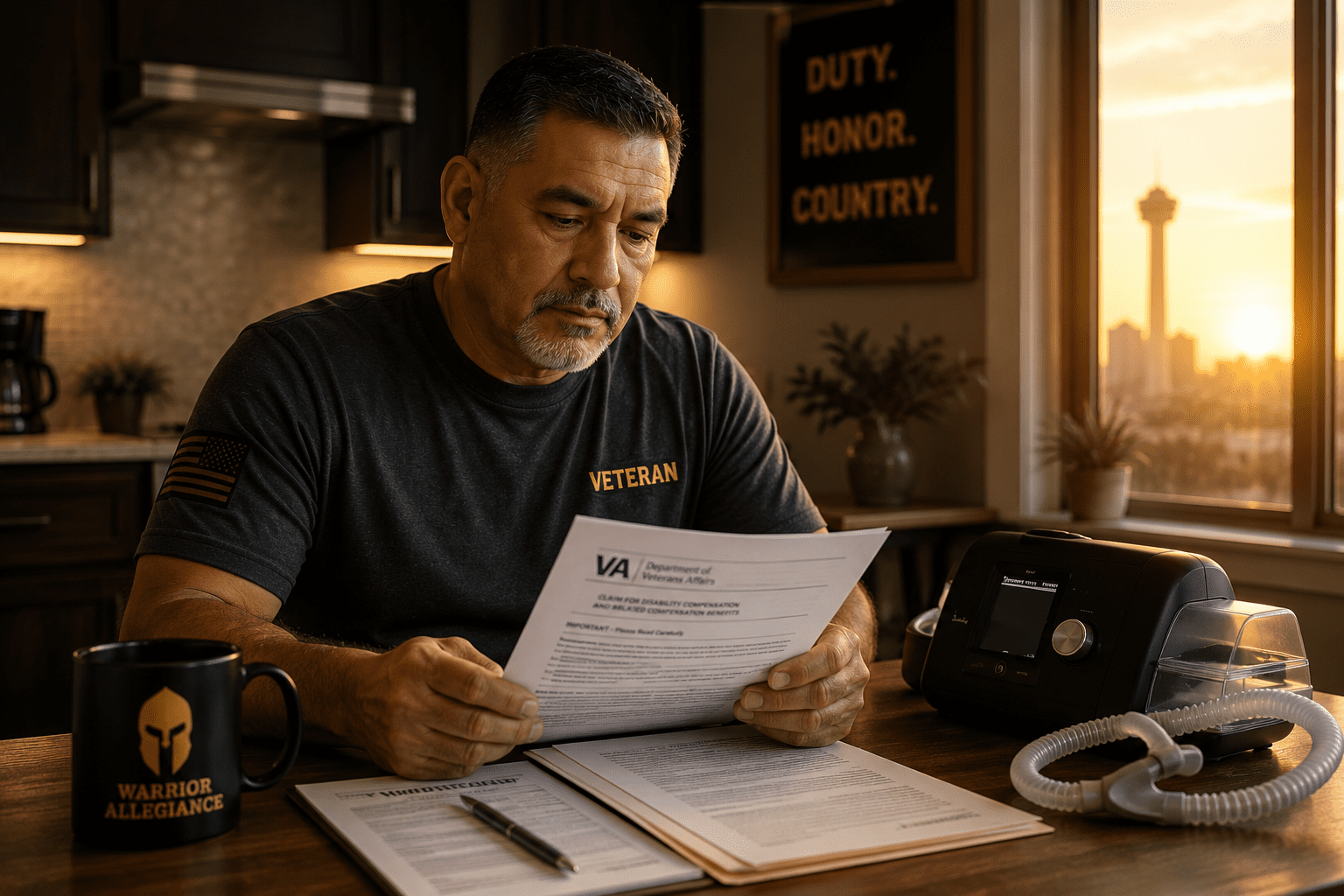
Sleep Apnea VA Claim San Antonio: Ratings, Proof, and How to File
Filing a sleep apnea VA claim San Antonio veterans can actually win starts with understanding two things: how the VA rates the condition, and how you prove it ties back to your service. Many local veterans wake up exhausted, rely on a CPAP machine every night, and still get denied because the paperwork never connected their diagnosis to active duty. Therefore, this guide walks you through the 2026 ratings, the nexus evidence the VA wants, and the exact steps to file here in San Antonio.
Sleep Apnea VA Claim San Antonio: Is It a VA Disability?
Why So Many San Antonio Veterans Get Denied
Most denials are not about whether you have sleep apnea. Instead, they come down to the nexus, the missing bridge between your military service and your current diagnosis. The VA sees the CPAP, but nobody explained why your service caused or aggravated the condition.
Furthermore, timing trips people up. Plenty of veterans were not diagnosed until years after separation, so the VA assumes the condition started later. Consequently, a strong sleep apnea VA claim San Antonio reviewers will approve hinges on connecting today's symptoms to documented service events, exposures, or a secondary condition you already have rated.
VA Sleep Apnea Ratings at a Glance (2026)
Before you file, it helps to see where you might land. The table below breaks down each VA disability sleep apnea rating, the medical criteria, and roughly what it pays a single veteran with no dependents under the 2026 VA disability compensation rates.
| VA Rating | Medical Criteria (DC 6847) | Approx. Monthly Pay (2026) | What It Means for You | CPAP Required |
|---|---|---|---|---|
| 0% | Diagnosed, asymptomatic | $0 | Service-connected, no pay yet | No |
| 30% | Persistent daytime hypersomnolence | ~$524 | Documented fatigue, no device | No |
| 50% | Requires a CPAP or breathing device | ~$1,102 | Most common approved rating | Yes |
| 100% | Chronic respiratory failure or tracheostomy | ~$3,737 | Rare, severe cases | Often |
As shown, the CPAP requirement is the line most claims cross. Therefore, your prescription and compliance records carry real weight.
Sleep Apnea Secondary to PTSD: The Angle Most Claims Miss
Here is where many San Antonio veterans leave money on the table. Sleep apnea secondary to PTSD is a well-documented connection, because PTSD, weight gain from medication, and disrupted sleep architecture can all contribute to or worsen sleep apnea. In short, if you already carry a PTSD rating, you may qualify for sleep apnea as a secondary condition.
Moreover, this route often succeeds when a direct service connection stalls. A doctor explains how your service-connected PTSD aggravated your breathing disorder, and that nexus opinion does the heavy lifting. If this sounds like your situation, our breakdown of a PTSD VA claim in San Antonio pairs directly with this strategy.
Do You Need a CPAP for a VA Sleep Apnea Rating?
Not exactly, although it helps. You can be service-connected at 0 or 30 percent without a CPAP. However, the jump to a 50 percent rating specifically requires that your sleep apnea requires the use of a breathing assistance device such as a continuous positive airway pressure machine, per 38 CFR 4.97. Accordingly, a documented prescription matters far more than simply owning the machine.
For the full medical picture, our VA sleep apnea disability guide covers each rating tier in detail.
Sleep Apnea VA Claim San Antonio: How to File Step by Step
Filing locally is straightforward once your evidence is in order. Follow these steps:
- Gather your diagnosis. Secure a sleep study, ideally a recent one, that confirms obstructive, central, or mixed sleep apnea.
- Build the nexus. Connect your diagnosis to service directly, or secondary to a rated condition like PTSD, with a medical opinion.
- Collect supporting evidence. Add buddy statements, treatment records, and your CPAP prescription.
- File a Fully Developed Claim. Submitting complete evidence up front speeds review and reduces denials. You can file a claim directly with the VA or let an advocate prepare it first.
- Attend your C&P exam. San Antonio veterans typically complete compensation and pension exams through the South Texas VA system, including the Audie L. Murphy VA Hospital.
How Warrior Allegiance Strengthens Your Claim
Warrior Allegiance is veteran-owned, and our team pairs administrative specialists with licensed doctors who write the nexus opinions the VA actually credits. As a result, we maintain an approval rate above 90 percent on the claims we support. Equally important, we work for the veteran, not the VA, so every strategy aims at the rating you have earned.
For example, when a direct connection looks weak, we pivot to a secondary route. When a sleep study is outdated, we coordinate a current one. Ultimately, the goal is a clean, evidence-backed sleep apnea VA claim San Antonio adjudicators can approve the first time. Learn more about Warrior Allegiance and how we got here.
Contact Our San Antonio Team →Frequently Asked Questions
Q1 How do I file a sleep apnea VA claim San Antonio veterans actually get approved? +
Q2 How much VA disability will I get for sleep apnea? +
Q3 Can you get VA disability for sleep apnea secondary to PTSD? +
Q4 Do I need a CPAP machine to get a VA sleep apnea rating? +
Q5 Where do San Antonio veterans complete their sleep apnea C&P exam? +
Sleep Apnea VA Claim San Antonio: Get Yours Reviewed Today
You served. You earned these benefits. Now let a team that fights for veterans handle the paperwork, the nexus, and the deadlines so you can focus on rest. A stronger sleep apnea VA claim San Antonio veterans trust is one conversation away.