
Memorial Day 2026: Date, Meaning, Traditions, and How to Honor It the Right Way
When Is Memorial Day 2026?
Memorial day 2026 falls on Monday, May 25. However, knowing the date is only the beginning. Memorial Day is one of the most important — and most misunderstood — observances in the United States. Furthermore, millions of Americans observe the day without knowing its specific purpose, its proper traditions, or what separates it from Veterans Day. Consequently, this guide covers everything: the history, the meaning, the traditions, and the ten most meaningful ways to honor the day properly in 2026.
What Is Memorial Day 2026 — History and Meaning
Memorial Day is a national day of remembrance for U.S. military service members who died while serving. It grew from the Civil War tradition of decorating the graves of fallen soldiers — a practice communities began in 1865 as the war ended. Congress established it as a federal holiday in 1971. Furthermore, the Uniform Monday Holiday Act moved the observance to the last Monday of May — producing the three-day weekend most Americans recognize today. However, that scheduling decision has contributed to the gradual shift toward treating memorial day 2026 as a leisure holiday rather than a day of mourning.
Memorial Day vs Veterans Day — The Difference That Matters
These two holidays honor different populations. Memorial Day honors service members who died while serving. Veterans Day, observed every November 11, honors all veterans — living and deceased. Consequently, the emotional register of each day differs significantly. Memorial Day is specifically a day of mourning and remembrance. Veterans Day is a broader celebration of military service. Furthermore, the flag protocol, appropriate greetings, and observance types differ between the two. Understanding that distinction is itself a form of respect for memorial day 2026.
| Holiday | Who It Honors | Date 2026 | Primary Purpose |
|---|---|---|---|
| Memorial Day 2026 | U.S. service members who died while serving | Monday, May 25, 2026 | Mourning and remembrance of the fallen |
| Veterans Day 2026 | All veterans — living and deceased | Wednesday, November 11, 2026 | Recognition and gratitude for all military service |
Why Memorial Day 2026 Still Matters
Memorial day 2026 matters because sacrifice that goes unremembered eventually goes unacknowledged. Every generation of Americans who did not live through a major war risks losing the specific understanding of what military service can cost. Furthermore, the youngest WWII veterans are now approaching 100 years old. The generation that fought in Korea is in their late 80s. Moreover, post-9/11 veterans — now in their 30s and 40s — carry wounds, losses, and the memory of fallen friends that most of their civilian peers never encounter. Consequently, Memorial Day provides a designated moment for the entire nation to pause and acknowledge that cost together. Specifically, it preserves the principle that those who gave everything deserve to be remembered specifically — not generically, and not only while their families are still living to remind us.
How to Observe Memorial Day 2026 — 10 Meaningful Ways
Each of the following ways to observe memorial day 2026 reflects a different dimension of genuine remembrance. For a deeper exploration of meaningful versus performative observances, the how to honor memorial day veteran guide covers each action in full detail. These ten actions are organized from the most direct to the most lasting.
1–3. Presence, Pause, and Protocol
First, visit a cemetery or memorial. Walking among headstones or reading names on a memorial wall makes sacrifice tangible. Furthermore, many national cemeteries place flags at each headstone before Memorial Day — and the American Legion and VFW welcome community volunteers for this tradition. Second, observe the National Moment of Remembrance at 3:00 PM local time. Congress designated this national pause in 2000 through the National Moment of Remembrance Act. Additionally, taking sixty seconds at 3:00 PM connects a personal act to a national one. Third, fly the American flag correctly: half-staff from sunrise until noon, then full-staff for the remainder of the day. The half-staff position represents mourning. The transition to full-staff represents a living nation's resilience.
4–6. People, Stories, and Community
Fourth, reach out to a Gold Star family directly. For families who lost a service member, memorial day 2026 is not abstract — it is a specific anniversary of loss. A phone call or visit carries more weight than any social media post. Fifth, learn the story of a specific fallen service member. The Defense POW/MIA Accounting Agency publishes records of fallen Americans. Moreover, sharing what you learn with family — especially children — transfers memory across generations. Sixth, attend a local ceremony. American Legion posts, VFW chapters, and municipalities host ceremonies nationwide. Your attendance signals to organizing veterans that the community values the observance — not just the long weekend.
7–10. Action, Donation, Reflection, and Ongoing Support
Seventh, volunteer with a veterans organization. Memorial Day generates awareness. However, veteran organizations need year-round support — and this weekend is an ideal starting point. Eighth, donate to a verified military family support organization. Grief support, educational scholarships, and emergency financial assistance for military families depend on community contributions. Ninth, take time for personal reflection. Even five minutes of quiet thought about the cost of the freedoms the day is set aside from honors the spirit of the observance. Tenth — and most lastingly — support veterans beyond memorial day 2026. The veterans who came back carry the memory of those who did not. Additionally, many live with unrated service-connected conditions the VA has not yet compensated. Helping a living veteran file a claim is a direct extension of Memorial Day's underlying principle.
See Why Filing a VA Claim Before Memorial Day Matters →What NOT to Do on Memorial Day 2026
Understanding what to avoid is as important as knowing the right observances. Specifically, avoid saying "Happy Memorial Day" as a casual greeting. The day honors the dead. Happiness is not the appropriate emotional register. Furthermore, avoid treating memorial day 2026 purely as a retail holiday or barbecue weekend without any engagement with its meaning. Additionally, avoid flying the flag at full-staff all day — the protocol designates half-staff until noon specifically. Moreover, avoid generic social media tributes that substitute for substantive action. Veterans — particularly those who lost fellow service members — consistently describe hollow online tributes as the observance they find least meaningful. Consequently, small genuine actions outperform large symbolic gestures on this particular day.
Memorial Day 2026 Traditions — What They Mean and Why They Persist
Several specific traditions govern how Americans observe memorial day 2026. Each one carries meaning that predates the holiday's commercialization and connects directly to its origin as a day of mourning.
The Flag at Half-Staff
Presidential proclamation governs the flag protocol for Memorial Day. The flag flies at half-staff from sunrise until noon. At noon, it rises to full-staff for the rest of the day. The half-staff position represents the nation's mourning for those who died in service. The noon transition represents the living nation moving forward — carrying that grief without being consumed by it. Furthermore, this protocol applies to all flags flown by federal agencies, military installations, and encouraged for all Americans. Specifically, the protocol differs from general half-staff periods that run all day — the Memorial Day schedule is intentional and distinct.
The National Moment of Remembrance and Taps
The 3:00 PM National Moment of Remembrance was established by Congress in 2000. It invites all Americans to pause for one minute wherever they are. Additionally, the playing of Taps — the traditional military bugle call — marks memorial ceremonies across the country. Taps originated during the Civil War and carries specific meaning: it signals the end of a soldier's day. Furthermore, many communities play a recorded version at local ceremonies. At national cemeteries, a live bugler performs the call at a designated grave. Consequently, both the 3:00 PM pause and the sound of Taps represent among the most direct connections between modern observance and the day's Civil War origins.
Cemetery Visits and Flag Placement
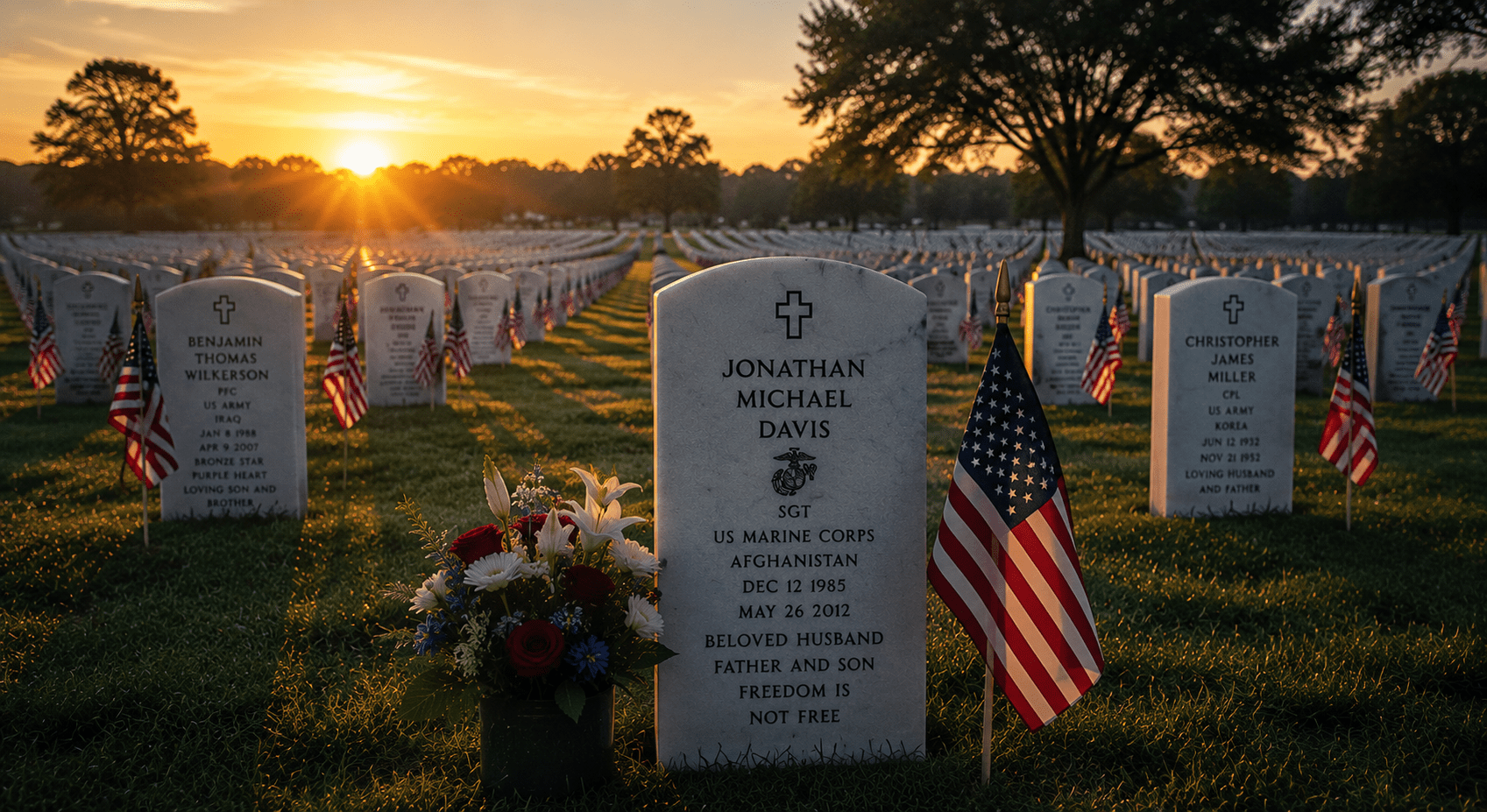
Visiting national and local cemeteries is among the oldest memorial day 2026 traditions. Specifically, the tradition of placing flowers and flags at military graves predates the federal holiday designation by decades. Today, volunteers place small American flags at each headstone in national cemeteries in the days before Memorial Day. Moreover, the American Legion and VFW organize community flag placement events at both national and local cemeteries. Participating in these events is one of the most direct ways to observe the day — and one that many Americans do not know is open to the public.
Frequently Asked Questions — Memorial Day 2026
Q1 When is Memorial Day 2026? +
Q2 What is the difference between Memorial Day and Veterans Day? +
Q3 How should you observe Memorial Day 2026 properly? +
Q4 What is the National Moment of Remembrance on Memorial Day? +
Q5 How can I support veterans on Memorial Day 2026 and beyond? +
Memorial Day 2026 — Remember the Fallen, Fight for the Living
Memorial day 2026 is Monday, May 25. However, the day's meaning extends far beyond its date. It belongs to every family that placed a Gold Star in their window. It belongs to every veteran who came home carrying the weight of those who did not. Furthermore, honoring that sacrifice does not end at sundown. The veterans who survived carry service-connected conditions that the VA has not fully compensated. Helping them file — or helping yourself file — is a direct extension of Memorial Day's principle. Warrior Allegiance fights for veterans year-round. No upfront fees. No risk. A 90%+ approval rate. Start your free consultation today.