
VA Caregiver Program for Parents 2026: The Complete Guide for Families Caring for a Disabled Veteran
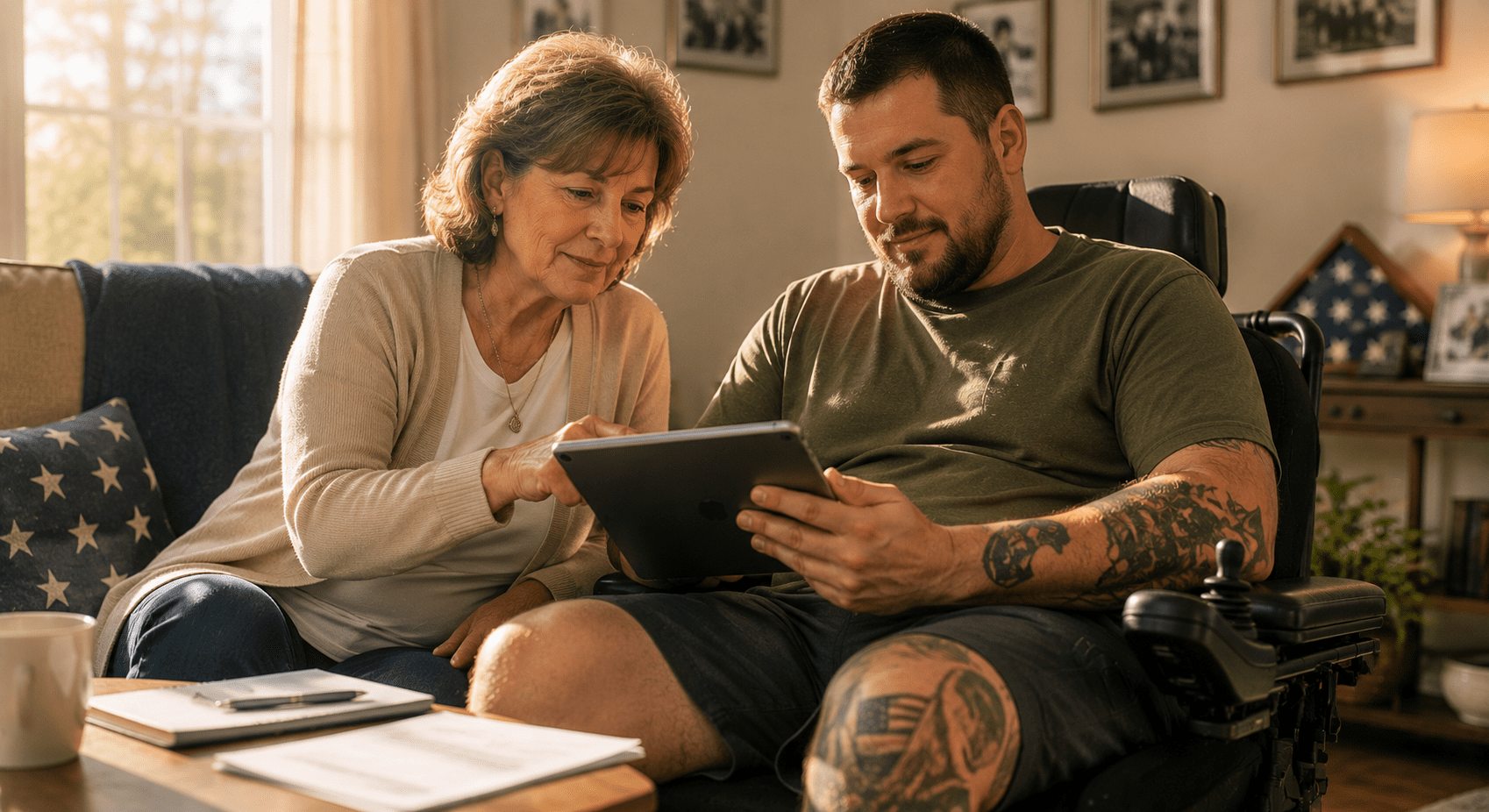
The va caregiver program for parents is real, it pays a monthly stipend, and parents are explicitly named as eligible caregivers under PCAFC — yet most parent caregivers have never heard of it, and many who have assume it applies only to spouses. Both assumptions are costing families thousands of dollars a year in VA caregiver benefits they have already earned by providing daily care for a disabled veteran. This guide covers who qualifies, what the va caregiver program for parents pays in 2026, how the MISSION Act expanded eligibility to all service eras, and how the veteran's disability rating directly affects the stipend and tier a parent caregiver receives.
Can a Parent Qualify for the VA Caregiver Program and Receive a Monthly Stipend?
Why Most Parent Caregivers Are Missing the VA Caregiver Program for Parents Entirely
The assumption that PCAFC applies only to spouses is one of the most costly misconceptions in the veteran family benefits space. Consequently, thousands of parent caregivers are providing daily care — reorganizing their finances, their housing, and their daily lives — without the monthly stipend, health insurance, or respite support they are legally entitled to receive. Furthermore, the MISSION Act expanded the va caregiver program for parents to cover veterans of all eras in 2022. Parents of Vietnam-era, Gulf War, and Korean War veterans who were told before 2022 that they did not qualify because of their veteran's service era are now eligible to reapply under updated eligibility rules. Additionally, the program is not well-publicized — unlike VA disability compensation, which generates public awareness campaigns, PCAFC remains largely unknown to the families it was designed to serve.
Moreover, the connection between the veteran's disability rating and the parent caregiver's stipend and tier is a relationship most families never make. A veteran's well-documented, accurately rated conditions directly strengthen the va caregiver program for parents application — determining not just whether a parent qualifies, but how much they receive. Therefore, pursuing a strong disability claim and a PCAFC application at the same time is the most strategic path for any parent caregiver whose veteran is currently unrated or under-rated. According to the VA's official PCAFC program page, parents are specifically listed among eligible family member caregivers alongside spouses, children, and siblings.
What the VA Caregiver Program for Parents Pays — Every Benefit at a Glance
PCAFC provides parent caregivers five distinct benefit categories. Each addresses a specific dimension of the caregiving burden — financial, medical, logistical, emotional, and educational. For the official program overview including how to contact a VA Caregiver Support Coordinator near you, see the VA Caregiver Support Program resource page or call the Caregiver Support Line at 1-855-260-3274.
| PCAFC Benefit | What It Provides | Eligibility Condition |
|---|---|---|
| Monthly Stipend | Tax-free monthly payment calculated on BLS home health aide wage rates for the caregiver's geographic area — estimated $800–$2,500/month depending on location and care tier | Primary caregiver designation under approved PCAFC application |
| Health Insurance | Medical, dental, and mental health coverage for caregivers not otherwise insured | Primary caregiver not enrolled in other health insurance |
| Respite Care | Up to 30 days per year of temporary relief care — in-home or at a VA facility | Primary caregiver under approved application; veteran enrolled in VA healthcare |
| Mental Health Services | Individual and group counseling, peer support, and mental health resources for the caregiver | Primary caregiver under approved PCAFC application |
| Education and Training | Skill-building, safety training, and care coordination resources | Primary and secondary caregivers under approved application |
Approved PCAFC caregivers also receive access to a dedicated VA Caregiver Support Coordinator, travel benefits when accompanying the veteran to VA appointments, and direct access to the Caregiver Support Line. Notably, the monthly stipend does not affect the veteran's VA disability compensation — the va caregiver program for parents and the veteran's disability claim operate as separate benefit streams that complement rather than offset each other.
PCAFC Eligibility Requirements for the VA Caregiver Program for Parents
Parents qualify for PCAFC under the same eligibility framework as spouses — the program was designed for the family member who shows up, regardless of their relationship to the veteran. Specifically, five conditions must be met. First, the veteran must have a serious service-connected injury or illness — including TBI, psychological trauma, or other serious condition incurred or aggravated in the line of duty on or after May 7, 1975 for current program eligibility. Second, the veteran must need personal care services — requiring assistance with at least one activity of daily living, neurological supervision, or regular mental health services.
Third, the parent must be the primary caregiver — only one person can hold the primary caregiver designation under PCAFC. A parent who shares caregiving duties must establish that they are the primary provider. Fourth, the parent must live with the veteran or certify willingness to do so — a condition most parents providing full-time care already meet. Fifth, the parent must be at least 18 years old and capable of providing safe, effective care — a standard a parent who has been caregiving for months or years will demonstrate readily. Furthermore, the va caregiver program for parents application process includes a home visit by a VA clinical team. Consequently, documenting the specific daily care activities the parent performs before that visit ensures the assessment reflects the full scope of their caregiving role — and the appropriate tier level.
What the MISSION Act Changed for the VA Caregiver Program for Parents
Before 2018, PCAFC was available only to caregivers of post-9/11 veterans. Parents caring for Vietnam-era, Gulf War, or Korean War veterans had no access to the va caregiver program for parents' financial benefits regardless of how severe their veteran's condition was or how many years they had been providing care. The MISSION Act changed that in 2018 with a phased rollout fully implemented in 2022. Parents caring for veterans of any service era are now eligible to apply for PCAFC benefits — provided the veteran meets the serious injury standard.
Specifically, this MISSION Act expansion created a large population of families who are providing care without benefits they now qualify for. Parents of Vietnam-era veterans with serious service-connected conditions — TBI, PTSD, Agent Orange-related disabilities, and chronic conditions — may now qualify for the full va caregiver program for parents benefit suite. Similarly, parents of Gulf War, Korean War, and peacetime-era veterans are no longer excluded on the basis of service era alone. Therefore, any parent who applied before 2022 and was denied because of their veteran's service era should reapply immediately — the eligibility rules have changed entirely. Additionally, parents of veterans whose conditions were expanded under the 2026 PACT Act toxic exposure presumptives may now meet the serious injury standard for the first time. For the complete picture of how these federal benefit changes interact, the federal veterans benefits guide for 2026 covers every program in detail.
How the Veteran's Disability Rating Affects the VA Caregiver Program for Parents — and How to Maximize Both
This is the connection most families never make — and the one that matters most strategically for the va caregiver program for parents. The veteran's disability rating, the documentation of their service-connected conditions, and the strength of their claim file all directly affect the serious injury standard determination, the care needs tier, and therefore the monthly stipend a parent caregiver receives. Consequently, pursuing a strong disability claim and a PCAFC application simultaneously is the most financially impactful strategy for any parent caregiver whose veteran is currently unrated or under-rated.
Specifically, a higher rating strengthens the serious injury determination — because the VA's PCAFC assessment draws on the same evidence base as the disability rating. Furthermore, a higher tier determination means a higher monthly stipend, because tier is based on the veteran's documented functional limitations. Those limitations are most credibly established through the same medical evidence that supports a well-rated disability claim. Additionally, a veteran who reaches 100% — or TDIU — unlocks CHAMPVA for eligible dependents, maximizes the caregiver program's benefit tier, and positions the entire family for the highest level of VA support available. Understanding how the VA's combined ratings formula works is therefore the foundation of every parent caregiver's strategic plan. The VA math formula guide explains that calculation step by step — including which conditions, at which rating levels, will move the combined total most significantly for both the veteran's claim and the family's caregiver program outcome.
Start a Free Veteran Claim and Caregiver Review →How to Apply for the VA Caregiver Program for Parents — Step by Step
The application process is more straightforward than most parent caregivers expect. First, confirm the veteran's eligibility — verify that the veteran is enrolled in VA healthcare and that their service-connected conditions meet the serious injury standard. If the veteran's conditions are under-documented, strengthening the claim file before applying improves the application's outcome directly. Second, contact the VA Caregiver Support Coordinator at the nearest VA medical center before submitting the application — they guide families through the local assessment process and ensure the application is complete. The Caregiver Support Line is available at 1-855-260-3274.
Third, complete VA Form 10-10CG — the Application for the VA Program of Comprehensive Assistance Family Caregivers. The form requires information about both the veteran and the parent caregiver, and the veteran must sign to consent to the caregiver designation. Fourth, prepare for the home visit assessment by documenting the specific daily care activities the parent performs — bathing, medication management, mobility assistance, supervision for neurological symptoms — to ensure the assessment reflects the full scope of caregiving. Fifth, respond promptly to any VA requests for additional medical documentation to avoid processing delays. Finally, consider getting professional support for both the caregiver application and the veteran's disability claim simultaneously — because the strongest va caregiver program for parents applications are supported by well-documented veteran claim files. For military spouse caregivers navigating the same programs, the military spouse VA benefits guide for 2026 covers the full caregiver and dependent benefit landscape.
Frequently Asked Questions About the VA Caregiver Program for Parents
Q1 Can a parent be a VA caregiver and receive a monthly stipend? +
Q2 How much is the VA caregiver stipend for parents in 2026? +
Q3 Does the VA caregiver program cover parents of veterans from all eras? +
Q4 How does the veteran's disability rating affect my va caregiver program for parents application? +
Q5 What happens if the VA caregiver program application is denied? +
You Have Been Caring for Your Veteran — Now Let the VA Help Care for You
The va caregiver program for parents exists because that sacrifice is real, documented, and compensable. The monthly stipend, the health insurance, the respite care, and the mental health services are not charity — they are the nation's recognition that the caregiver's sacrifice carries the same weight as the veteran's service. They were earned by every parent who reorganized their life around a veteran's recovery. They require a filed application to receive — and a veteran's disability claim strong enough to support the eligibility and tier determination that maximizes them. Warrior Allegiance works with veterans and their families — including parent caregivers — to ensure every benefit the family has earned is fully claimed. That means building the veteran's disability claim to the rating level that supports the strongest possible PCAFC outcome. No upfront fees. No risk. Just a team that believes serving veterans and their families is exactly what they were called to do. Start your free consultation today.