
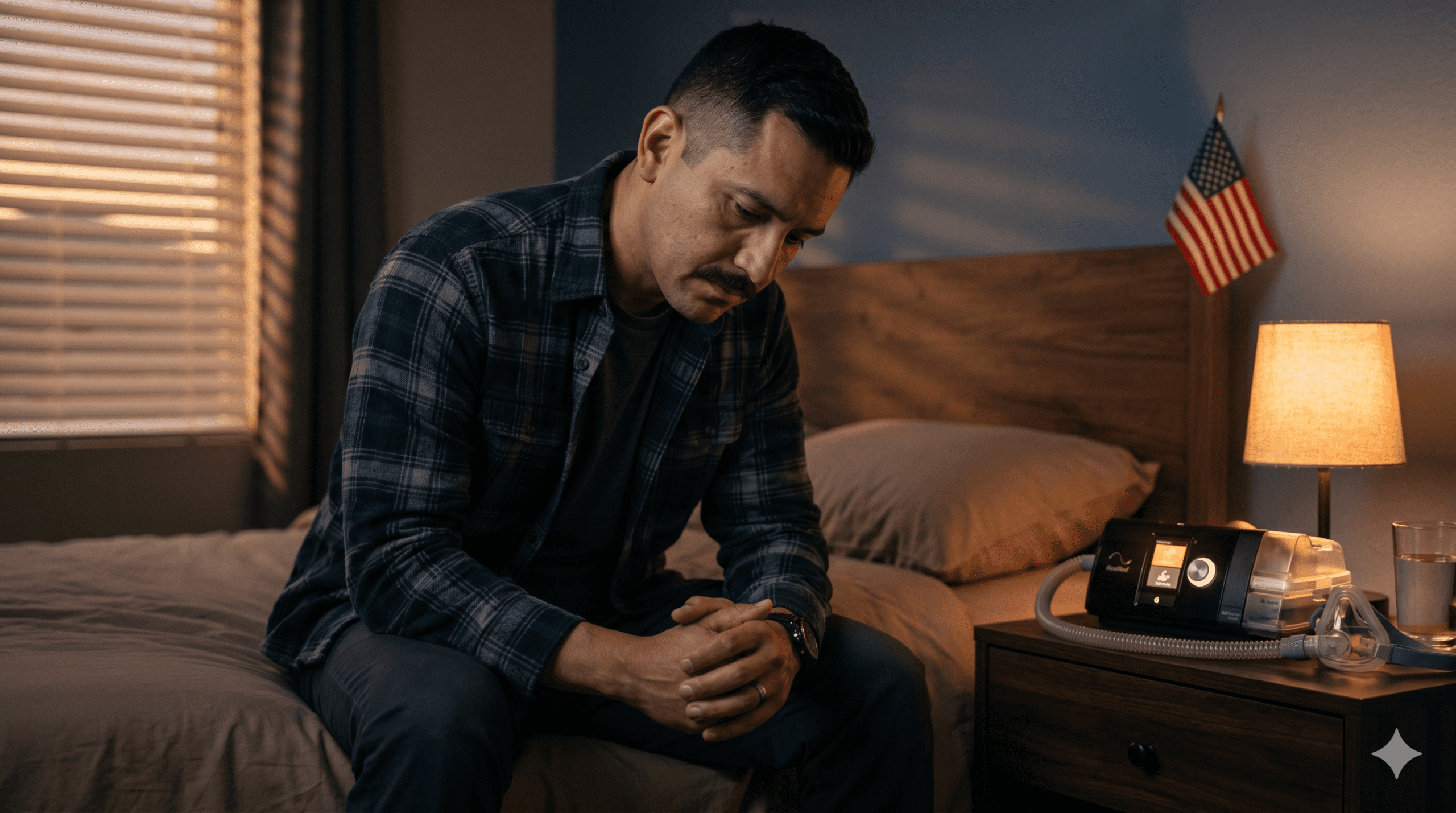
If You Have PTSD and Use a CPAP, You May Be Owed $1,100+ More Per Month in VA Benefits
You already fought to get your PTSD rating. You know the paperwork, the C&P exams, the waiting. But if you are also using a CPAP machine every night and have never filed a secondary VA disability claim for sleep apnea, there is a strong chance the VA owes you more money — starting right now. Sleep apnea secondary to PTSD is one of the most commonly approved secondary claims in the VA system, and one of the most frequently missed. This post explains exactly what it takes to file, what evidence the VA needs to see, and what your PTSD and sleep apnea VA benefits could look like on the other side.
🇺🇸 Veterans Crisis Line If you’re struggling with PTSD symptoms, you are not alone. Free, confidential support is available 24 hours a day, 7 days a week. Call or text 988, then press 1. Chat at VeteransCrisisLine.net.
Does PTSD Cause Sleep Apnea? What the Research Shows
Does PTSD cause sleep apnea? Yes — and the evidence is stronger than most veterans realize. PTSD disrupts sleep at a neurological level. Hypervigilance keeps the brain in a near-constant state of alert, preventing the deep, restorative sleep stages where the body regulates breathing. Nightmares and night sweats cause repeated arousal throughout the night, fragmenting sleep architecture in ways that directly contribute to obstructive sleep apnea.
There is also a medication pathway. Many veterans with PTSD are prescribed psychiatric medications — antidepressants, mood stabilizers, or antipsychotics — that carry significant weight gain as a side effect. That weight gain, particularly around the neck and airway, is one of the leading physical causes of obstructive sleep apnea. Does PTSD cause sleep apnea through this route? The clinical record says yes, consistently.
A 2018 VA study on obstructive sleep apnea comorbid with PTSD found a statistically significant higher incidence of sleep apnea in veterans with PTSD — higher than in either condition alone. The research supports what many veterans already feel: the sleep apnea service connection to PTSD is real, documented, and the VA’s own science confirms it.
What Is a Secondary VA Disability Claim — And How Does It Work?
A secondary VA disability claim lets you get rated for a new condition caused or made worse by a condition the VA has already service-connected. You do not need to re-prove your military service. The service connection is already established through your PTSD rating. What you are proving now is the medical link between that rated condition and your sleep apnea.
The VA’s legal standard is straightforward: your sleep apnea must be “at least as likely as not” caused or aggravated by your service-connected PTSD. That phrase means the evidence does not have to be certain — just at least 50/50 in your favor. Given the research backing the PTSD and sleep apnea connection, meeting that standard is very achievable with the right documentation.
What makes the secondary VA disability claim process powerful is what it does not require. No new in-service incident. No fresh military records. No re-litigation of your service history. Just a current diagnosis, a rated condition to anchor it to, and a clear medical opinion linking the two. Can you claim sleep apnea secondary to PTSD for VA disability if your PTSD is already rated? Absolutely — and that existing rating is your strongest asset.
Severity | Symptoms | VA Rating | 2026 Monthly Pay |
Asymptomatic | Documented but no current symptoms | 0% | $0 |
Mild | Persistent daytime hypersomnolence | 30% | $524.31 |
Moderate / Requires CPAP | CPAP prescribed and in use | 50% | $1,133.68 |
Chronic respiratory failure | Requires tracheotomy or oxygen | 100% | $3,737.85 |
Rates shown for a single veteran with no dependents, 2026. VA Diagnostic Code 6847.
What VA Rating Do You Get for Sleep Apnea Secondary to PTSD?
The VA rates sleep apnea under Diagnostic Code 6847. The rating schedule is cleaner than most VA schedules — and the most critical detail is this: if your doctor has prescribed a CPAP machine, you are automatically eligible for a 50% CPAP VA disability rating.
A 50% VA sleep apnea rating pays $1,133.68 per month as a standalone in 2026. But it does not add directly on top of your PTSD rating. The VA uses combined ratings math — the whole person method — so the numbers do not simply stack.
Here is a concrete example. A veteran with a 70% PTSD rating has 30% remaining whole-person value. A 50% sleep apnea secondary to PTSD rating takes 50% of that remaining 30%, adding 15 points — producing a combined disability of 85%, which rounds to 90%. For a single veteran, 90% pays $2,241.91 per month in 2026 compared to $1,773.05 at 70%. That is $468.86 more every month — over $5,600 per year — for a condition already affecting your sleep every single night.
A second scenario: a veteran at 50% PTSD adds a 50% sleep apnea rating. That produces a combined 75%, rounding to 80%, which pays $1,933.15 per month versus $1,133.68 at 50% alone. Every current rating level tells a similar story — a successful sleep apnea secondary to PTSD VA rating increase almost always moves the monthly number.
What Evidence Do You Need to Claim Sleep Apnea Secondary to PTSD?
Three elements are required to win a sleep apnea secondary to PTSD claim. Miss any one of them and the VA will deny it.
A current, formal sleep apnea diagnosis. Symptoms alone are not enough. VA sleep apnea secondary condition claims require a diagnosis backed by a sleep study — either through VA healthcare or a private sleep clinic. If you snore, wake up gasping, feel exhausted regardless of hours slept, or already use a CPAP, schedule that study immediately. The sleep study is the foundation everything else rests on.
An existing service-connected PTSD rating. Your secondary claim needs a primary rated condition to connect to. If you have PTSD symptoms but have never filed for them, file for both simultaneously and ask the VA to evaluate sleep apnea as secondary to PTSD in the alternative.
A sleep apnea secondary to PTSD nexus letter. This is the document that connects the dots. A nexus letter is a written medical opinion stating your sleep apnea is at least as likely as not caused or aggravated by your service-connected PTSD. It must be specific — referencing your medical history, your PTSD diagnosis, and the documented research linking the two conditions. Generic templates do not win claims. Warrior Allegiance works directly with medical professionals who know exactly what a winning nexus letter requires.
Buddy statements from fellow veterans or family members describing your sleep disturbances, nightmares, and daily impact add supporting weight. A personal statement in your own words rounds out a fully developed claim.
How to Prove Your Sleep Apnea Is Connected to PTSD
Proving sleep apnea secondary to PTSD means building a medical argument the VA examiner cannot dismiss. There are three nexus pathways that consistently hold up, and a strong claim uses at least one explicitly.
The hypervigilance and sleep disruption pathway. PTSD keeps the nervous system in a state of chronic alert. That persistent arousal interrupts natural sleep cycles and prevents the deep, regulated breathing the airway depends on during sleep. A nexus letter documenting this mechanism — tied to your specific PTSD symptoms — directly satisfies the at least as likely as not standard. This is how to prove sleep apnea is secondary to PTSD most cleanly.
The medication-induced weight gain pathway. If you were prescribed psychiatric medications for PTSD and gained significant weight, document it. Weight gain around the neck is a primary mechanical cause of obstructive sleep apnea. A doctor who traces the timeline from PTSD diagnosis to medication to weight change to sleep apnea onset builds a causal chain the VA has approved in thousands of similar claims.
The chronic stress and sleep architecture pathway. Long-term psychological stress from combat PTSD alters the brain’s regulation of breathing during sleep. Medical literature — including the VA’s 2018 research — supports this link directly. A nexus letter that references peer-reviewed research alongside your personal medical history carries significantly more weight than one stating an opinion without support.
One practical note: private nexus letters consistently outperform VA examiner opinions in contested claims. VA examiners work under time pressure and often produce templated responses. A private letter written for your specific case — by a physician who has reviewed your full history — is the stronger document.
How Much Can You Get — Real Numbers for Sleep Apnea Secondary to PTSD
How much back pay can you get for sleep apnea secondary to PTSD? The answer depends on your current rating and how long your claim takes to process — but the numbers are significant either way.
If you file an intent to file a VA disability claim today and spend the next several months building your sleep apnea secondary claim, your effective date is locked from today. When the claim is approved, back pay runs from that intent to file date through the decision. At a monthly increase of $468, a six-month processing window produces nearly $2,800 in retroactive pay. A ten-month window pushes past $4,600. At higher rating jumps, those numbers climb further.
Secondary claims for sleep apnea often take time to develop properly — the sleep study alone can take weeks, and a strong nexus letter takes additional preparation. Every day that passes without an intent to file on record is a day of potential back pay that cannot be recovered. File the intent to file first. Build the claim second. That sequence protects every dollar.
👉 Intent to File a VA Disability Claim: Your 5-Minute Move That Could Mean Thousands in Retro Pay 👉 Common VA Disabilities: What Veterans Can Claim
How Warrior Allegiance Builds the Sleep Apnea Secondary to PTSD Claim
Can you get VA disability for sleep apnea if you already have a PTSD rating? Without question — and Warrior Allegiance has helped veterans do exactly that. Most veterans who miss this claim are not missing it because they do not qualify. They are missing it because no one told them it existed, or because they filed without a strong enough nexus letter and got denied.
Warrior Allegiance reviews your existing ratings to identify every compensable secondary condition you may be missing. For sleep apnea service connection claims, that means coordinating sleep study documentation, working with medical professionals to produce nexus letters built to the VA’s evidentiary standard, preparing a fully developed claim, and coaching you through the C&P exam so your real symptoms are accurately recorded.
With a 90%+ favorable outcome rate and no upfront fees, Warrior Allegiance only succeeds when you do. Whether you are filing this secondary claim for the first time or appealing a denial with stronger evidence, the team is ready.
👉 Why It’s Better to File with Warrior Allegiance
You've Already Fought for Your Country — Let Warrior Allegiance Fight for Your Benefits
You earned your PTSD rating the hard way. If sleep apnea has been stealing your rest every night since, that condition deserves its own VA sleep apnea rating — and the monthly compensation that comes with it.
Sleep apnea secondary to PTSD is a winnable claim. The research supports the connection. The VA’s own rating schedule rewards it at 50% the moment a CPAP is prescribed. And veterans who file with proper documentation and a strong nexus letter win it every day.
Warrior Allegiance is ready to help you build the case, gather the evidence, and cross the finish line.
📞 Call us: 1-800-837-1106 🌐 Visit: warriorallegiance.com 💬 Free consultation. No upfront fees. No risk. Just results.
At Warrior Allegiance, we fight for every veteran until they receive what they deserve.
Frequently Asked Questions About Sleep Apnea Secondary to PTSD
What is sleep apnea secondary to PTSD for VA disability?
Sleep apnea secondary to PTSD is a VA disability claim where a veteran seeks a separate rating for sleep apnea by proving it was caused or worsened by their already service-connected PTSD. It does not require re-proving military service — only a formal sleep apnea diagnosis, an existing PTSD rating, and a medical nexus letter linking the two conditions.
Do I need a sleep study to claim sleep apnea secondary to PTSD?
Yes. The VA requires a formal sleep apnea diagnosis backed by a sleep study before assigning a rating under VA Diagnostic Code 6847. Symptoms alone are not enough, even severe ones. Schedule a sleep study through the VA or a private sleep clinic as the first concrete step in building your secondary VA disability claim.
What VA rating do I get for sleep apnea if I use a CPAP?
A CPAP prescription qualifies a veteran for a 50% CPAP VA disability rating under Diagnostic Code 6847 — paying $1,133.68 per month in 2026 for a single veteran with no dependents. This rating applies regardless of how well the CPAP controls your symptoms. The prescription itself is the qualifying factor, not symptom severity.
Can I file for sleep apnea secondary to PTSD if my PTSD claim is already rated?
Yes — an existing PTSD rating is actually your strongest asset for this claim. Your service connection is already established. Filing a secondary VA disability claim for sleep apnea connected to an already-rated PTSD is one of the most straightforward paths to approval. You are adding a new linked condition, not relitigating your service history.
What happens if the VA denies my sleep apnea secondary claim?
A denial is not the end. File a Supplemental Claim with new and relevant evidence — most commonly a stronger, more specific sleep apnea secondary to PTSD nexus letter or additional medical records. Most denials on secondary sleep apnea claims trace back to insufficient nexus documentation. A well-built nexus letter submitted on a Supplemental Claim resolves the majority of them.